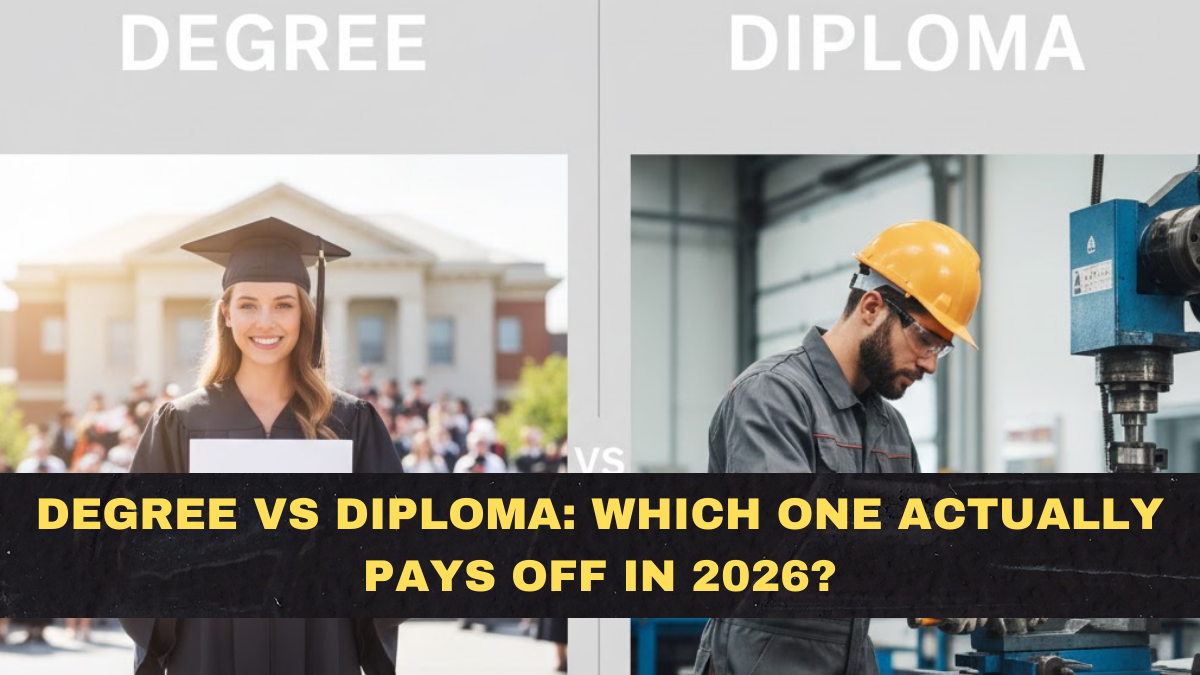
For decades, degrees were treated as the only respectable route to success in India. Diplomas were often dismissed as shortcuts or second-tier options meant for those who could not secure degree admissions. In 2026, this hierarchy is breaking down rapidly. Employers, industries, and even students are questioning whether long academic degrees still justify the time, cost, and delayed earnings they demand.
The degree vs diploma debate today is not about prestige. It is about outcomes. Students want to know what actually leads to employment, income stability, and career growth. The answer is no longer uniform, and that uncertainty is forcing families to rethink old assumptions.

Why Degrees Became the Default Choice
Degrees dominated because they were once reliable filters. A degree signaled discipline, knowledge, and long-term commitment. Government jobs, corporate roles, and professional fields all reinforced this pathway.
Social perception also played a major role. Degrees were associated with respect and upward mobility, especially for middle-class families.
By 2026, however, this default status is being challenged by rising costs and inconsistent returns.
How Diplomas Quietly Gained Relevance
Diploma courses were designed to be practical, shorter, and skill-focused. For years, they were undervalued due to social bias rather than performance.
As industries evolved faster than academic curricula, diplomas started aligning more closely with job needs. Hands-on training became a competitive advantage.
In 2026, employers increasingly value job readiness over academic duration, bringing diplomas back into serious consideration.
Cost and Time: The First Major Difference
Degrees typically require three to four years, sometimes more. Diplomas often take one to two years.
This difference matters financially. Degree students spend longer without income while accumulating tuition and living expenses. Diploma students enter the workforce earlier.
When outcomes are similar, time and cost efficiency tilt the equation in favor of diplomas.
Employability and Job Readiness
Many degree programs emphasize theory. Practical exposure is often limited or delayed until the final year.
Diploma courses usually integrate hands-on training from the start. Students graduate with usable skills rather than just concepts.
In 2026, employers facing skill shortages often prefer candidates who can contribute immediately, regardless of qualification type.
Salary Reality: Short Term vs Long Term
Degree holders often start with slightly higher entry salaries in structured roles. However, growth is not guaranteed and depends heavily on skill development.
Diploma holders may start lower, but those with strong practical ability often catch up quickly or surpass peers through experience.
The degree vs diploma salary gap is narrowing significantly by 2026, especially in private sector roles.
Industries Where Diplomas Perform Better
Technical trades, design, media production, logistics, healthcare support, and certain IT roles favor practical skills.
In these sectors, diplomas often outperform degrees because execution matters more than credentials.
Students targeting these industries benefit more from focused training than extended academic study.
Where Degrees Still Hold Strong Value
Degrees remain essential in regulated professions such as law, medicine, research, and higher education.
They also matter for roles requiring deep theoretical grounding or eligibility for advanced studies.
In 2026, degrees still pay off when aligned with the right field and supported by skills.
The Risk of Choosing Either Without Strategy
Both degrees and diplomas fail when chosen blindly. A degree without skills leads to unemployment. A diploma without market relevance leads to stagnation.
The problem is not the qualification, but the lack of planning. Students often choose based on reputation rather than outcomes.
Strategic alignment matters more than labels.
Parental Perception vs Market Reality
Parents often push degrees due to familiarity and social validation. Diplomas feel risky because they challenge tradition.
However, employers increasingly prioritize competence over convention. This gap between family belief and market reality creates tension.
In 2026, informed families are starting to ask better questions instead of defaulting to degrees.
Which Option Pays Off More in 2026
There is no universal answer. Degrees pay off when paired with skills, internships, and clarity of direction. Diplomas pay off when chosen for in-demand skills and applied consistently.
The highest returns come from alignment, not duration. Students who understand their strengths and industry needs outperform those who follow prestige alone.
The degree vs diploma question is ultimately about fit, not hierarchy.
Conclusion: Outcomes Matter More Than Labels
In 2026, careers are no longer decided by degrees alone. Diplomas have earned legitimacy by delivering real-world value.
The smarter question is not which qualification sounds better, but which one moves you closer to employability and growth.
Students who choose based on outcomes rather than tradition build careers that are flexible, resilient, and financially sustainable.
FAQs
Is a diploma better than a degree in 2026?
It depends on the industry and skill demand. Diplomas work well in practical, skill-driven fields.
Do employers prefer degrees over diplomas?
Many employers prioritize skills and experience over qualification type, especially in private sectors.
Can diploma holders earn as much as degree holders?
Yes, with experience and strong skills, diploma holders often match or exceed degree-based salaries.
Are diplomas accepted for government jobs?
Some roles accept diplomas, but many government positions still require degrees.
Is a degree useless without skills?
A degree without applied skills significantly reduces employability in 2026.
How should students choose between degree and diploma?
By evaluating industry demand, personal strengths, cost, time, and long-term career goals rather than social pressure.