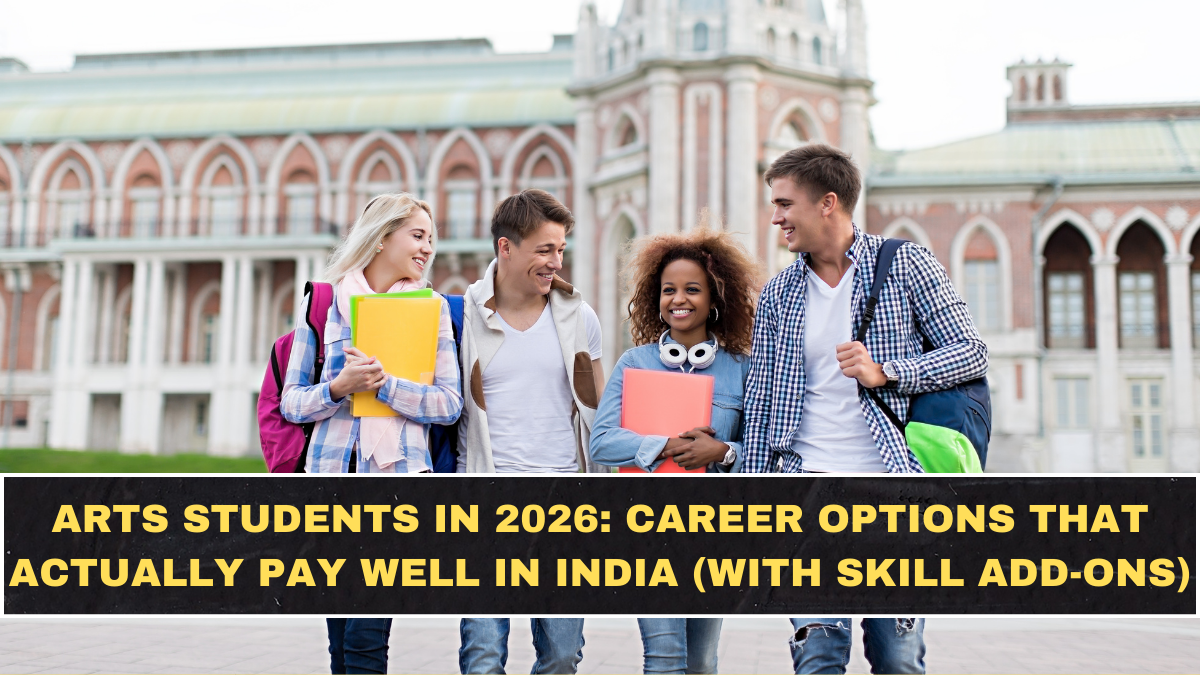
Arts students in India have lived for years under a damaging myth: that choosing humanities means choosing low income and limited growth. By 2026, this belief is not just outdated, it is actively harmful. The job market has shifted away from degree labels toward applied skills, communication strength, and domain understanding.
The real issue is not that arts students lack opportunities. The issue is that many are pushed into random degrees without a clear career direction or practical skill plan. This article breaks down realistic, India-focused career options for arts students in 2026, along with the skill add-ons that actually raise income potential over time.
Why Arts Degrees Are No Longer Career Killers in 2026
The economy now values interpretation, communication, research, and problem framing more than rote technical ability in many roles. Automation has reduced demand for repetitive tasks, while human judgment and context-setting have gained value.
Arts students naturally develop reading depth, analytical thinking, writing clarity, and social awareness. When these strengths are combined with practical skills, they translate into employable profiles.
In 2026, arts is not a dead end. Directionless arts education is.
Top Career Options for Arts Students in India
Law remains one of the strongest structured paths. BA LLB suits students who can handle heavy reading, long timelines, and competitive exams, with long-term stability rather than instant rewards.
Civil services and state-level government exams also continue to attract arts graduates due to syllabus alignment and conceptual overlap. Success depends on discipline, not background.
In the private sector, policy research, public affairs, content strategy, and communications roles are expanding steadily.
Media, Content, and Communication Roles
Content creation is no longer limited to journalism. Roles now include content strategy, editorial management, brand storytelling, instructional writing, and UX writing.
Arts students with strong language skills and domain focus perform well here. Income grows with portfolio quality and niche depth rather than years alone.
In 2026, generic writing pays poorly. Specialized communication pays well.
Psychology, Sociology, and People-Centric Careers
Psychology graduates increasingly move into HR, counseling, behavioral research, and organizational development roles.
Clinical psychology requires long-term academic commitment, but applied psychology roles grow faster with certifications and internships.
In 2026, people-centric roles reward emotional intelligence combined with structured thinking.
Education, Training, and Knowledge Roles
Teaching is evolving beyond classrooms. Corporate training, instructional design, curriculum development, and edtech roles are growing.
Arts graduates who add digital tools, assessment design, or subject specialization stand out.
In 2026, education roles scale better with skills than with degrees alone.
Skill Add-Ons That Increase Salary Potential
Writing plus SEO, research plus data interpretation, psychology plus HR analytics, and history plus policy research are powerful combinations.
Basic tech literacy, presentation skills, and domain-specific certifications amplify employability significantly.
In 2026, the right skill pairing matters more than the degree title.
Salary Reality for Arts Students
Starting salaries are usually modest compared to technical roles, but growth curves differ widely.
Arts careers reward consistency, reputation, and specialization over time. Those who stay generic stagnate.
In 2026, arts careers are long games, not quick wins.
Common Mistakes Arts Students Must Avoid
Choosing degrees without understanding career pathways is the biggest mistake.
Another error is assuming passion alone will pay bills. Skills convert passion into income.
In 2026, clarity beats motivation.
Conclusion: Arts Careers Work When Strategy Exists
Arts students are not disadvantaged by their stream. They are disadvantaged by lack of planning.
With the right skill add-ons and realistic expectations, arts graduates build stable, meaningful, and financially viable careers in India.
In 2026, arts is not the problem. Direction is.
FAQs
Can arts students earn well in India in 2026?
Yes, with specialization and skill development. Generic paths pay poorly.
Is law the best option for arts students?
It is a strong option for those ready for long-term commitment, not a shortcut.
Are government exams easier for arts students?
Syllabus alignment helps, but competition remains intense.
Which skills increase income fastest for arts students?
Communication, research, domain expertise, and digital tools.
Is content creation a stable career?
Yes, when focused on niches and strategy rather than generic writing.
Do arts careers take longer to grow?
Often yes, but growth is steady when skills and reputation compound.