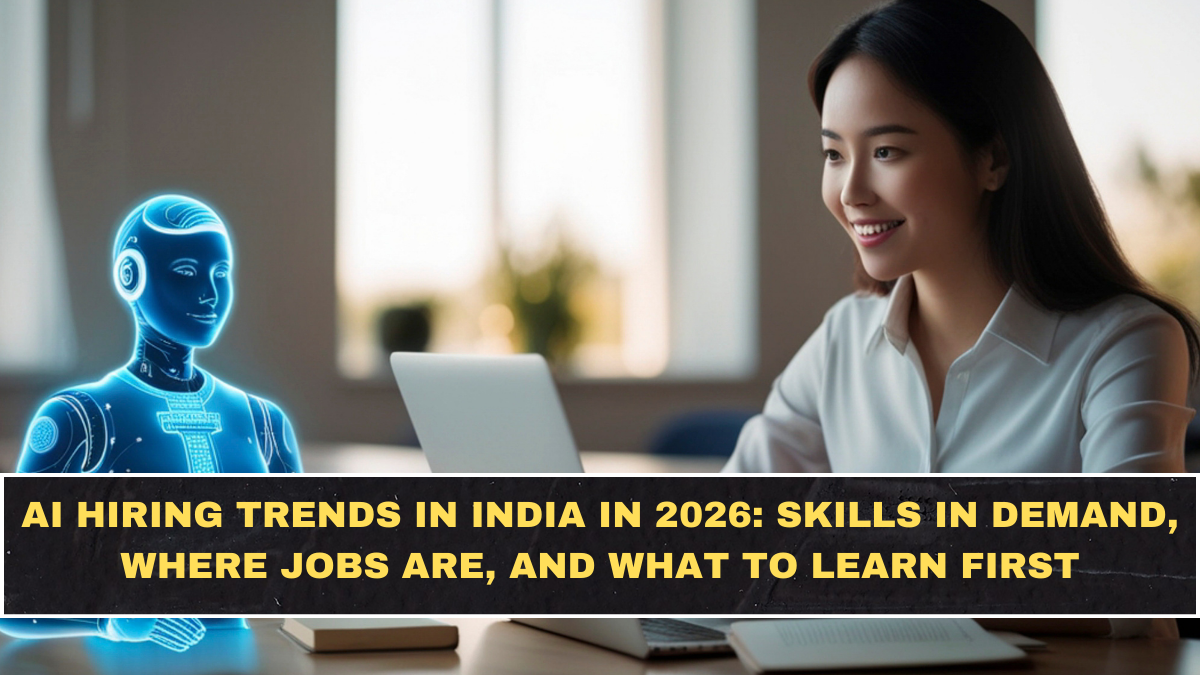
AI hiring trends in India in 2026 look very different from the hype-driven narratives that dominated earlier years. The market has moved past curiosity hiring and experimental roles. Companies are now recruiting with clearer intent, tighter role definitions, and stronger expectations around real-world impact. This shift has reduced noise but increased the quality bar, making it essential for candidates to understand where genuine demand exists.
What stands out in 2026 is that AI hiring is no longer limited to pure “AI engineers.” Roles now span engineering, governance, operations, analytics, and business integration. Employers are not asking whether to use AI anymore. They are asking how to scale it responsibly, reliably, and cost-effectively. This mindset has reshaped both hiring priorities and skill requirements across India.
Why AI Hiring Has Become More Selective
AI hiring slowed down in volume but increased in seriousness. Early-stage experimentation exposed many weak implementations that failed to deliver value or created operational risk.
Companies learned that hiring generalists without clear deployment plans leads to wasted effort. As a result, they now recruit only when there is a defined problem to solve.
In 2026, hiring managers prefer fewer candidates with stronger alignment rather than large teams with unclear roles.
Skills That Are Most in Demand
The most in-demand AI skills are practical rather than theoretical. Employers value candidates who can integrate models into workflows, not just train them.
Skills around agentic systems, retrieval-based architectures, evaluation, and monitoring are increasingly common in job descriptions. These reflect the shift toward production-grade AI.
In India, candidates who combine AI understanding with software or data engineering fundamentals are consistently prioritized.
Where AI Jobs Are Concentrated in India
AI hiring is concentrated in technology hubs with strong enterprise presence. Global Capability Centers play a major role because many global firms centralize AI work in India.
Product companies, fintech, and SaaS firms also hire AI talent for internal platforms and customer-facing tools.
In 2026, location matters less than alignment with enterprise use cases, but proximity to mature ecosystems still helps.
GenAI Roles Versus Traditional AI Roles
GenAI roles differ from traditional AI roles in focus and expectations. Traditional roles emphasize modeling and data science.
GenAI roles emphasize system integration, safety, and reliability. Candidates are expected to work with pre-trained models rather than build from scratch.
Understanding this distinction helps job seekers prepare appropriately instead of mixing incompatible skill sets.
AI Roles Beyond Engineering
Not all AI jobs are engineering roles. There is growing demand for AI product managers, AI governance specialists, and AI operations professionals.
These roles exist because AI systems interact with business processes, users, and regulations. Technical depth is important, but so is context and judgment.
In India, non-engineering AI roles are growing fastest in enterprises scaling AI adoption.
What Employers Expect From Entry-Level Candidates
Entry-level hiring focuses on fundamentals and learning ability rather than immediate expertise. Employers look for clarity of thinking and problem-solving skills.
Candidates are expected to understand AI concepts and demonstrate them through small but well-explained projects.
In 2026, strong communication and structured reasoning often outweigh raw technical brilliance at entry level.
Mid-Career AI Hiring Reality
Mid-career professionals are expected to bring impact quickly. Employers evaluate past work, ownership, and decision-making ability.
Transitioning into AI from adjacent roles is common, but candidates must show deliberate learning and practical application.
In India, mid-career AI hires are often expected to mentor juniors and shape systems, not just execute tasks.
Salary Trends and Skill Premiums
AI salaries in 2026 are more rational than in earlier years. Premiums exist, but they are tied to scarcity of specific skills rather than generic AI labels.
Skills related to deployment, reliability, and governance command higher compensation because they reduce organizational risk.
Candidates who position themselves around these skills negotiate more effectively.
Common Mistakes Job Seekers Make
A common mistake is chasing every new AI trend without depth. This leads to shallow profiles that struggle in interviews.
Another mistake is ignoring fundamentals. Weak system understanding limits long-term growth.
Hiring managers in 2026 value clarity and focus over buzzwords.
How to Decide What to Learn First
Job seekers should start with fundamentals, then specialize based on target roles. Learning everything at once is neither realistic nor effective.
Choosing a direction and building proof through projects is more valuable than collecting certificates.
In India’s competitive market, focused preparation leads to better outcomes.
Conclusion: AI Hiring Rewards Focus and Practical Skill
AI hiring trends in India in 2026 reflect a maturing market. The demand is real, but it is precise. Companies hire to solve defined problems, not to explore possibilities endlessly.
For candidates, this means success comes from understanding where AI creates value and building skills that support that value. Those who align learning with real-world needs, communicate clearly, and demonstrate ownership will continue to find strong opportunities as AI becomes part of everyday business.
FAQs
Is AI hiring still strong in India in 2026?
Yes, but hiring is more selective and focused on practical roles.
Which AI skills are most in demand?
Deployment, evaluation, system integration, and governance-related skills.
Are GenAI roles replacing traditional AI roles?
No, they coexist, but GenAI roles emphasize application over modeling.
Can non-engineers enter AI roles?
Yes, especially in product, governance, and operations-focused positions.
Do AI jobs pay more than other tech roles?
They can, but premiums depend on skill scarcity and impact.
What should beginners learn first for AI careers?
Fundamentals of data, systems, and basic AI concepts before specialization.