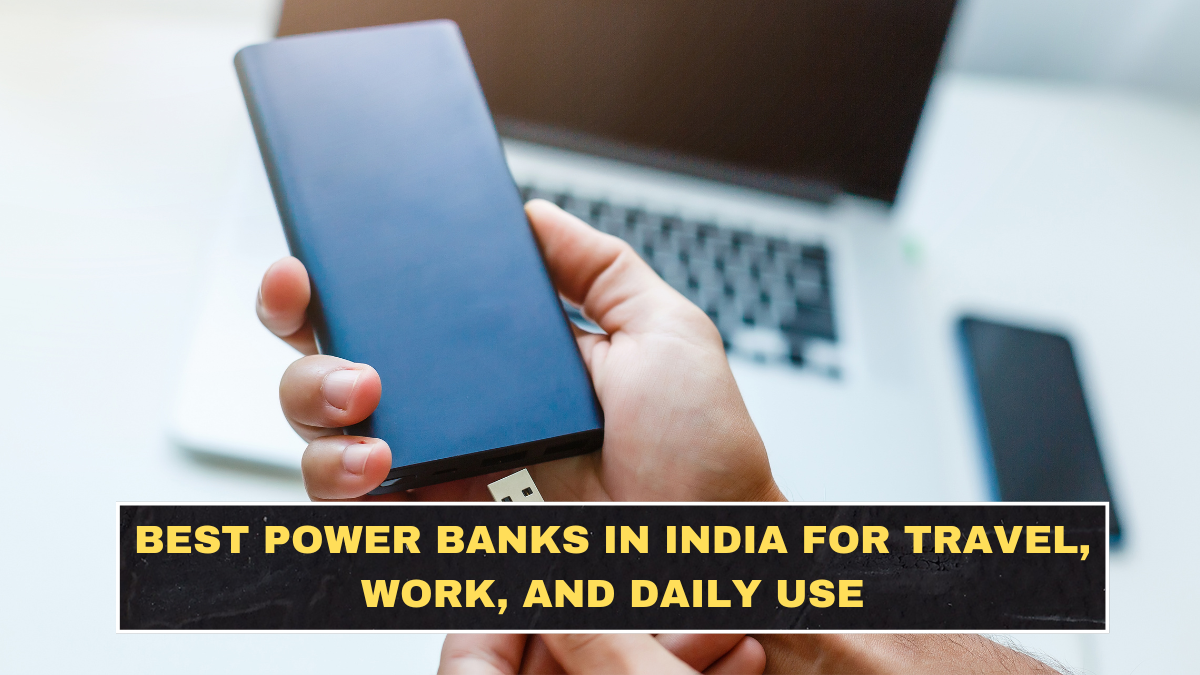
If you are searching for the best power banks in India, the smartest answer is not “buy the biggest one.” For most people, a 10,000mAh power bank is the better everyday pick because it is lighter and easier to carry. A 20,000mAh power bank makes more sense for travel, long office days, or charging more than one device. Amazon India’s bestseller pages are dominated by these two sizes, and current listings heavily feature 20W to 22.5W fast charging with USB-C input and output.
The real buying decision is simple. Match the power bank to your use case, not to marketing. If you only need emergency backup for your phone, 10,000mAh is usually enough. If you travel often or stay away from a charger for long hours, 20,000mAh is the safer choice.

Quick answer
For daily use, buy a 10,000mAh USB-C power bank with at least 20W charging. For travel or heavier backup, buy a 20,000mAh model with fast charging and multiple output ports. Also, in India, flight rules matter: Air India says power banks must be carried in cabin baggage, not checked baggage, and treats them as spare batteries.
Quick summary
The best power banks in India are the ones that balance capacity, charging speed, portability, and safety. Most buyers do not need oversized battery packs. They need a reliable model with USB-C, decent charging speed, and a capacity that fits real life. Amazon India’s current bestseller mix makes that pretty obvious: the mainstream market is centered on 10,000mAh and 20,000mAh, not random extreme-capacity gimmicks.
Quick buying table
| User type | Best choice | Why it works |
|---|---|---|
| Daily commuter | 10,000mAh | Lighter and enough for day backup |
| Student or office user | 10,000mAh | Easy to carry in bag or pocket |
| Frequent traveler | 20,000mAh | Better for long days and fewer recharges |
| Multi-device user | 20,000mAh | More practical for phone plus earbuds or tablet |
| Emergency-only buyer | 10,000mAh | Cheaper and less bulky |
What actually matters when buying the best power banks in India
Capacity matters, but it is not everything. Buyers keep fixating on mAh because it is easy to compare, but charging speed and port type matter just as much. Current Indian bestseller and product pages show that fast charging around 20W to 22.5W and USB-C two-way charging are now mainstream features, not premium extras.
That means a cheap power bank with a big printed capacity but slow charging can still be a bad buy. In real use, a power bank that recharges your phone slowly and takes too long to refill itself becomes annoying fast. The better buy is usually the balanced one, not the loudest one.
10,000mAh vs 20,000mAh: which is better in India?
For most people, 10,000mAh is the better daily-use size. It is easier to carry, better for metro or office life, and enough for regular top-ups. That is why this size keeps showing up in high-volume India listings.
A 20,000mAh power bank is better when portability matters less than endurance. It fits people who travel, work outside for long hours, or charge multiple devices. Amazon India bestseller pages and product listings strongly reflect how popular 20,000mAh fast-charging models are in that segment.
Why USB-C and fast charging should be non-negotiable
This is where many buyers still make dumb decisions. They compare capacity but ignore whether the power bank supports modern charging standards. A current 10,000mAh Amazon Basics listing highlights Type-C Power Delivery for both input and output, while a bestselling 20,000mAh model highlights 22.5W fast charging with dual input and output.
That matters because USB-C and faster charging improve both convenience and future usability. A power bank should not just charge your phone. It should recharge itself without wasting your time too.
Safety and trust matter more than flashy specs
Power banks are not just accessories. They are battery products, which means safety and compliance matter. BIS specifically lists “power banks for use in portable applications” in its recognized test-report formats, and MeitY’s Compulsory Registration framework exists to control sub-standard electronic products in India.
That is why buying random no-name units just because they are cheap is a bad move. The best power banks in India are not just about speed or size. They should come from sellers and brands that look credible and compliant, not from listings that scream specs and hide everything else.
Best power bank choice by real-life use case
| Need | Best fit |
|---|---|
| Pocket-friendly daily backup | 10,000mAh, 20W, USB-C |
| Office bag backup | 10,000mAh or slim 20,000mAh |
| Train and flight travel | 20,000mAh, fast charging, cabin-safe handling |
| Heavy phone use all day | 20,000mAh |
| Phone plus earbuds or tablet | 20,000mAh with multiple ports |
The mistake is thinking there is one “best” power bank for everyone. There is not. There is only the best fit for how you actually use your devices.
Flight rules in India matter if you buy for travel
A lot of buyers ignore this until airport security forces them to care. Air India says power banks cannot be carried in checked baggage and must be placed in cabin baggage. It also says they are treated as spare batteries, must be protected against short-circuiting, and only a maximum of two spare batteries can be carried.
Air India also says power banks and spare batteries cannot be placed in overhead bins. That matters for travelers, because a good travel power bank is not just about capacity. It is also about carrying it correctly and staying within airline rules.
What most buyers in India should avoid
Do not buy a bulky 20,000mAh power bank if your real need is just a daily top-up. Do not buy a cheap model with impressive printed specs but weak charging speed. Do not ignore USB-C. And do not buy for travel without checking cabin-baggage rules first.
The worst buying mistake is confusing “more” with “better.” Better means more useful, safer, easier to carry, and faster to charge.
What should most people buy now?
If you want the cleanest answer, here it is. Buy a 10,000mAh power bank with USB-C and around 20W charging for daily use. Buy a 20,000mAh fast-charging model if you travel, work long hours away from a socket, or charge more than one device. That matches where the Indian market is right now and solves the actual user problem instead of feeding spec obsession.
FAQs
Is 10,000mAh enough for most people?
Yes, for daily use it usually is. It is the more practical choice for commuters, students, and office users because it is lighter and easier to carry, and it remains one of the most common categories on Amazon India.
Is 20,000mAh better for travel?
Yes. A 20,000mAh power bank is usually better for longer trips, workdays outside, or multi-device charging. That is why India bestseller pages heavily feature fast-charging 20,000mAh models.
Are power banks allowed on flights in India?
Yes, but they must be carried in cabin baggage, not checked baggage. Air India clearly states that power banks are treated as spare batteries and cannot go in checked bags.
Should I only look at mAh when buying?
No. Capacity matters, but charging speed, USB-C support, portability, and safety matter too. Current bestselling India listings show that fast charging and USB-C are now part of the practical buying baseline.
Should I care about BIS or compliance?
Yes. BIS specifically includes power banks in its recognized testing framework, and India’s compulsory registration system exists to help keep sub-standard electronics out of the market.
Final takeaway
The best power banks in India are not the ones with the biggest number on the box. They are the ones that fit your day properly.
For most people, that means 10,000mAh for daily carry or 20,000mAh for travel, plus USB-C, fast charging, and basic trustworthiness. Buy for use, not for packaging.