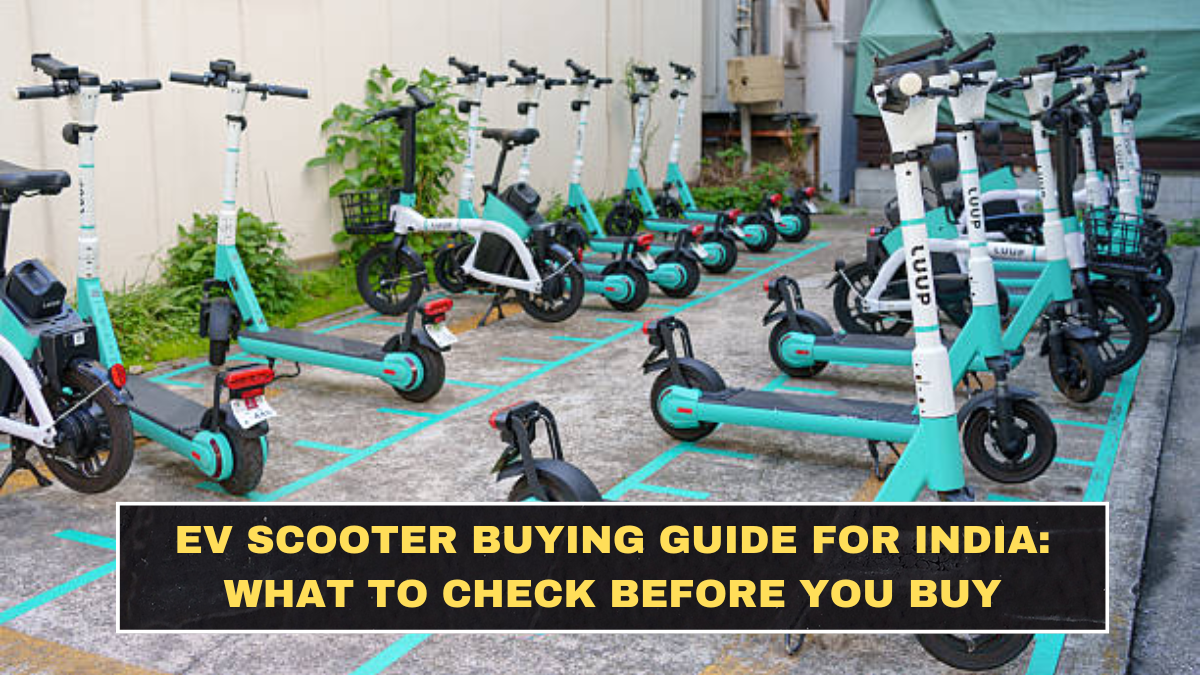
If you are planning to buy an EV scooter in India, do not start with claimed range alone. That is where many buyers fool themselves.
The smarter way is to check five things first: your daily riding distance, home charging convenience, real usefulness of the claimed range, service support, and total on-road value after subsidy. India’s PM E-DRIVE scheme was launched for the period from 1 October 2024 to 31 March 2026, so subsidy and scheme timing have been part of the buying equation recently.
For most city riders, an EV scooter makes sense when daily use is predictable and home charging is easy. If your routine is random, your parking has no charging access, or you often do long unplanned trips, the decision becomes less attractive.
Quick answer
Buy an EV scooter if you ride mostly in the city, have easy charging access, and want lower running costs than petrol for daily commuting.
Do not buy one just because the claimed range looks exciting. Models on sale in India already show how wide the spread is. Ather Rizta is advertised with up to 159 km IDC range, Chetak 3503 with 151 km, and Ola S1 X Gen 3 with up to 242 km depending on variant, but claimed figures are not the same as your everyday result.
Quick summary
An EV scooter is usually a good fit for office commutes, college rides, market runs, and city use.
The main things that matter are charging convenience, practical range, battery warranty, service network, and whether the scooter fits your real use, not just brochure numbers.
Quick buying table
| What to check | Good sign | Why it matters |
|---|---|---|
| Daily distance | Your routine is predictable | Easier to judge whether EV range is enough |
| Charging | Home or fixed parking charging available | Removes daily inconvenience |
| Claimed range | Enough margin above your real need | Reduces range anxiety |
| Battery warranty | Long warranty coverage | Better long-term confidence |
| Service support | Brand has working support in your area | Ownership matters after purchase |
| Price after subsidy | On-road price makes sense | Sticker price alone is not the real cost |
Range is important, but claimed range is not real life
This is the first mistake buyers make. They compare scooters only by brochure range.
Brands use certified or test-cycle figures, which are useful for comparison but not a guarantee of what you will get every day. Ather Rizta is listed at 159 km IDC range, Chetak 3503 at 151 km, and Ola S1 X Gen 3 at up to 242 km, but riding speed, traffic, load, road conditions, and mode selection all affect actual use.
So the practical question is not “Which scooter has the biggest number?” It is “Does this scooter leave enough buffer above my real daily distance?”
Charging convenience matters more than hype
A lot of people talk themselves into buying an EV scooter without thinking through charging.
If you have secure home parking with charging access, ownership is much easier. If you depend on uncertain public charging for routine daily use, the experience can become irritating. Ather promotes its Grid fast-charging network as India’s largest two-wheeler fast-charging network, while Ola says it has 970+ charging points across India on its site and brochures. That sounds useful, but public charging is still not a substitute for easy home charging for most riders.
Battery warranty is not a side detail
Buyers obsess over range and ignore warranty. That is backward thinking.
Ather Rizta highlights an 8-year battery warranty, and that kind of warranty matters because the battery is one of the biggest ownership concerns in an EV scooter. If two scooters look close on price and range, stronger battery assurance can be the smarter tie-breaker.
Running cost is lower, but only if your use case fits
This is where EV scooters genuinely make sense for many Indian buyers.
A scooter with a 3.0 to 3.5 kWh battery simply does not consume fuel the way a petrol scooter does. Current Indian models show battery sizes such as 3.0 kWh on the Chetak 3501 and 3.5 kWh on the Chetak 3503, while Ola and Ather models also scale by battery pack and variant.
But lower running cost alone is not enough. If charging is a hassle, service is weak in your city, or your usage pattern is badly matched to the scooter, the ownership experience can still feel wrong.
Subsidy and scheme timing should be checked before buying
This part is time-sensitive, so buyers should stop assuming old subsidy rules still apply.
The PM E-DRIVE scheme official portal says the scheme started on 1 October 2024 and, per the operational guidelines, was to run till 31 March 2026. Some brand showroom pages still show PM E-DRIVE subsidy as a price component on certain models.
That means you should verify the current applicable subsidy and on-road breakup at the time of purchase, not rely on outdated YouTube videos or old articles.
Service and support matter more than spec-sheet drama
A scooter is not a smartphone. You are not just buying features. You are buying ownership.
That means service access, parts availability, app stability, and support quality matter a lot after delivery. Ather, Ola, and Chetak all market connected features, charging ecosystems, and ownership support, but the right choice depends on how well that support actually exists in your city.
If the nearest useful service support is far away, your “smart” purchase can become a stupid one.
Which type of buyer should choose an EV scooter?
| Buyer type | EV scooter fit |
|---|---|
| City commuter | Strong fit |
| College or office rider | Strong fit |
| Local family errands | Strong fit |
| Rider with no charging access | Weak fit |
| Frequent long-distance rider | Mixed fit |
| Buyer chasing only subsidy | Bad reason to buy |
The pattern is obvious. EV scooters work best when daily riding is urban, predictable, and easy to recharge.
What most buyers in India should do
If your daily riding is mostly city-based and you can charge at home, an EV scooter is worth serious consideration.
If your routine depends on long unpredictable distances, weak charging access, or you are buying only because of marketing noise around EVs, slow down. The right decision is not “EV is the future.” The right decision is “Does this work for my life right now?”
FAQs
Is an EV scooter worth buying in India right now?
Yes, for many city riders it is. It makes the most sense for daily commuting, predictable distances, and home charging. India’s recent PM E-DRIVE support framework also shows that policy support has been part of the EV push.
How much range should I look for in an EV scooter?
You should look for a claimed range comfortably above your real daily use. Current models show a wide spread, from around 151 km on Chetak 3503 to 159 km on Ather Rizta and up to 242 km on Ola S1 X Gen 3 variants.
Is home charging necessary?
For most buyers, yes, or at least very helpful. Public charging networks exist, but home charging is still the more convenient and dependable setup for regular ownership.
Does battery warranty matter a lot?
Yes. A stronger battery warranty reduces long-term ownership anxiety. Ather Rizta, for example, prominently highlights an 8-year battery warranty.
Should I buy only because subsidy is available?
No. Subsidy can improve value, but it should not be the only reason to buy. Scheme periods and benefits can change, so you need to check the current on-road price and applicable support at the time of purchase.
Final takeaway
A good EV scooter in India is not the one with the loudest claimed range or the most hype.
It is the one that fits your daily distance, charging reality, service access, and budget. Buy for your routine, not for the brochure.