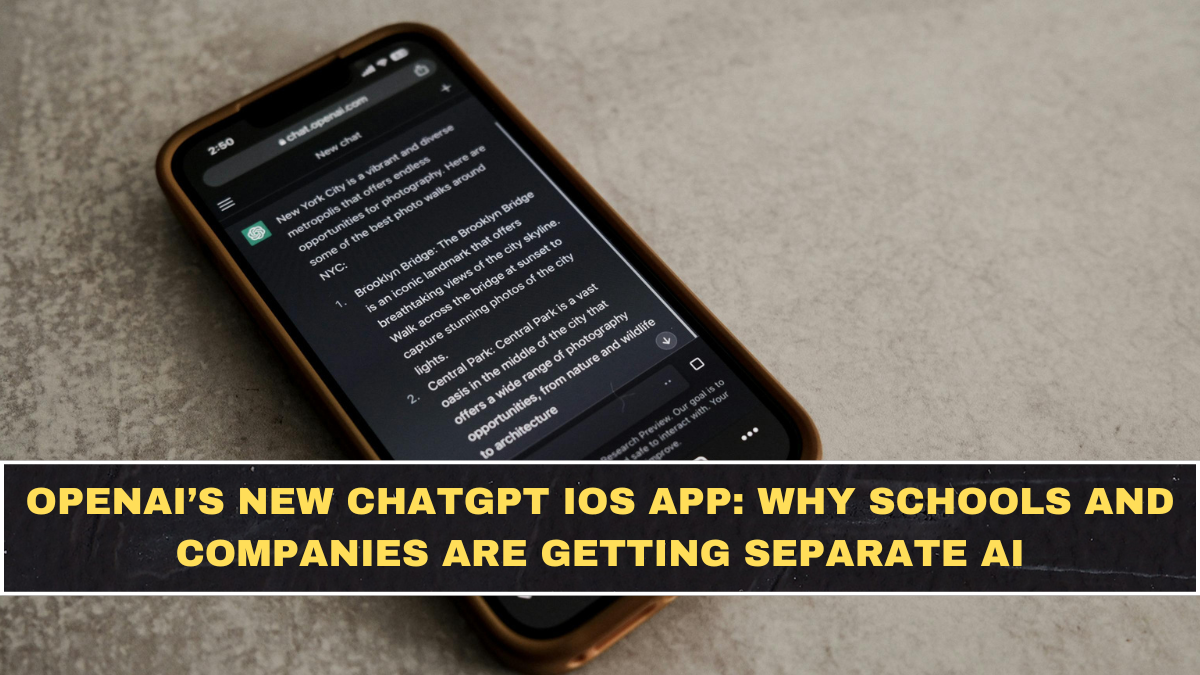
The viral framing around a “separate ChatGPT iOS app” needs a careful correction. OpenAI’s official pages currently point users to the official ChatGPT iOS app, while Enterprise and Edu users get organisation-level access, admin controls, privacy features and plan-specific tools inside the ChatGPT ecosystem. In simple words, this is not about downloading a random second app; it is about schools and companies getting a more controlled version of ChatGPT access.
That distinction matters because many readers may assume OpenAI has launched a completely different iPhone app only for offices and classrooms. The stronger and more accurate story is that OpenAI is pushing ChatGPT deeper into workplaces and education through official mobile access, Enterprise/Edu plans, app integrations and admin-managed features. That is still a big shift because AI is moving from casual personal use to structured institutional use.
Why Do Schools Need This?
Schools and universities do not need the same AI experience as casual users. They need privacy controls, safer deployment, admin oversight and tools that can support students, faculty, researchers and campus operations. OpenAI describes ChatGPT Edu as a version built for universities to deploy AI responsibly across campus communities, with enterprise-level security and controls.
This is why education-focused AI matters. A student may use ChatGPT for revision, writing help or coding practice, while a teacher may use it for lesson planning, feedback or classroom preparation. OpenAI also lists ChatGPT for Teachers as a secure workspace for verified U.S. K–12 educators, free through June 2027, with education-grade privacy and admin controls.
Why Do Companies Care?
Companies care because unmanaged AI use can create data-risk problems. Employees may paste confidential information into public tools, use inconsistent workflows or rely on unapproved AI outputs. OpenAI’s ChatGPT Enterprise page focuses on company-data connections, security, privacy and workplace integrations with tools like Microsoft SharePoint, GitHub, Google Drive and Box.
For businesses, the real value is not just “AI on iPhone.” The value is employees getting AI help while the organisation keeps control over data access, apps, permissions and workspace settings. That is why Enterprise and Edu releases matter more than a normal consumer app update; they turn ChatGPT into workplace infrastructure instead of only a chatbot.
What Makes It Different?
| Feature Area | Normal User Use | Enterprise/Edu Use |
|---|---|---|
| Access | Individual account | Organisation-managed workspace |
| Privacy | Personal settings | Admin and institutional controls |
| Data use | Personal conversations | Company or campus knowledge support |
| Tools | General ChatGPT features | Plan-specific apps, files and integrations |
| Audience | Everyday users | Employees, teachers, students and teams |
The table shows the real difference clearly. The app experience may look similar on the surface, but the control layer changes everything. Enterprise and Edu users are not just opening ChatGPT for random prompts; they can work inside managed environments where admins decide what tools, apps and data connections are allowed.
What Can Users Do On Mobile?
OpenAI’s official iOS FAQ says the ChatGPT app works on iPhone and supports conversation history access through the official app. OpenAI’s broader ChatGPT overview also highlights mobile voice conversations, which means the phone is becoming a serious AI interface, not just a backup screen when users are away from laptops.
For schools and companies, mobile support can be powerful but also dangerous if poorly managed. A teacher may prepare material on the move, a manager may summarise files before a meeting, and an employee may ask AI for quick task help. But without rules, users can also expose sensitive information, so institutional controls are not optional.
Why Is This A Big AI Shift?
- AI becomes official: Schools and companies can move from casual AI use to approved AI systems.
- Mobile changes behaviour: iPhone access makes AI available during meetings, travel and classroom prep.
- Admin controls matter: Institutions can manage privacy, apps and access instead of hoping users behave.
- Education use expands: Teachers and universities can use AI with more structured safeguards.
- Workplace AI gets serious: ChatGPT becomes part of daily operations, not only content generation.
The most important point is that AI adoption is becoming institutional. Earlier, people used ChatGPT individually and quietly. Now, companies and schools want official systems, training, privacy protection and integration with existing tools. That is where OpenAI’s Enterprise, Edu and teacher-focused plans are clearly heading.
Could This Create Problems?
Yes, and pretending otherwise would be naïve. Schools may face plagiarism concerns, overdependence, weak critical thinking and unequal access. Companies may face data leakage, bad AI outputs, compliance worries and employees trusting answers too quickly. The solution is not banning AI blindly; the solution is controlled use, clear policy and proper training.
OpenAI’s Study Mode also shows that the company is trying to push learning-focused AI instead of only answer-giving AI. Its help page says Study Mode is available across ChatGPT plans and works on iOS, Android and web, guiding users with interactive questions to build understanding. That kind of feature matters because education AI must teach, not simply complete homework.
What Is The Final Conclusion?
OpenAI’s ChatGPT iOS story is important, but the honest headline is not just “new app.” The real story is that ChatGPT is becoming more controlled, mobile and institution-ready for schools, universities and companies. Official OpenAI pages confirm the iOS app, ChatGPT Edu, Enterprise features, teacher-focused access and mobile support across learning tools.
For Google Discover readers, the hook is simple: AI is no longer just something people try at home for fun. It is entering classrooms, offices and admin-managed workspaces. The winners will be institutions that use it with rules, training and privacy controls. The losers will be the ones that either ban it blindly or allow it without any guardrails.
Frequently Asked Questions?
Is OpenAI launching a separate ChatGPT iOS app for schools and companies?
OpenAI’s official help pages point users to the official ChatGPT iOS app, while Enterprise and Edu users get organisation-level features, controls and access through managed ChatGPT workspaces. So the better way to understand it is not as a random second app, but as controlled institutional access to ChatGPT on mobile and web.
What is ChatGPT Edu?
ChatGPT Edu is OpenAI’s version of ChatGPT built for universities. It is designed to help students, faculty, researchers and campus operations use AI responsibly. OpenAI says it includes enterprise-level security and controls, which makes it different from casual personal use.
Why do companies need ChatGPT Enterprise?
Companies need ChatGPT Enterprise because workplace AI use involves sensitive files, internal data and team workflows. Enterprise features focus on privacy, security, admin controls and connections to company knowledge sources. This helps businesses use AI without relying only on unregulated personal accounts.
Can teachers use ChatGPT officially?
Yes, OpenAI offers ChatGPT for Teachers for verified U.S. K–12 educators, free through June 2027. OpenAI describes it as a secure workspace with education-grade privacy and admin controls. This shows that OpenAI is directly targeting classroom and school use, not only business users.