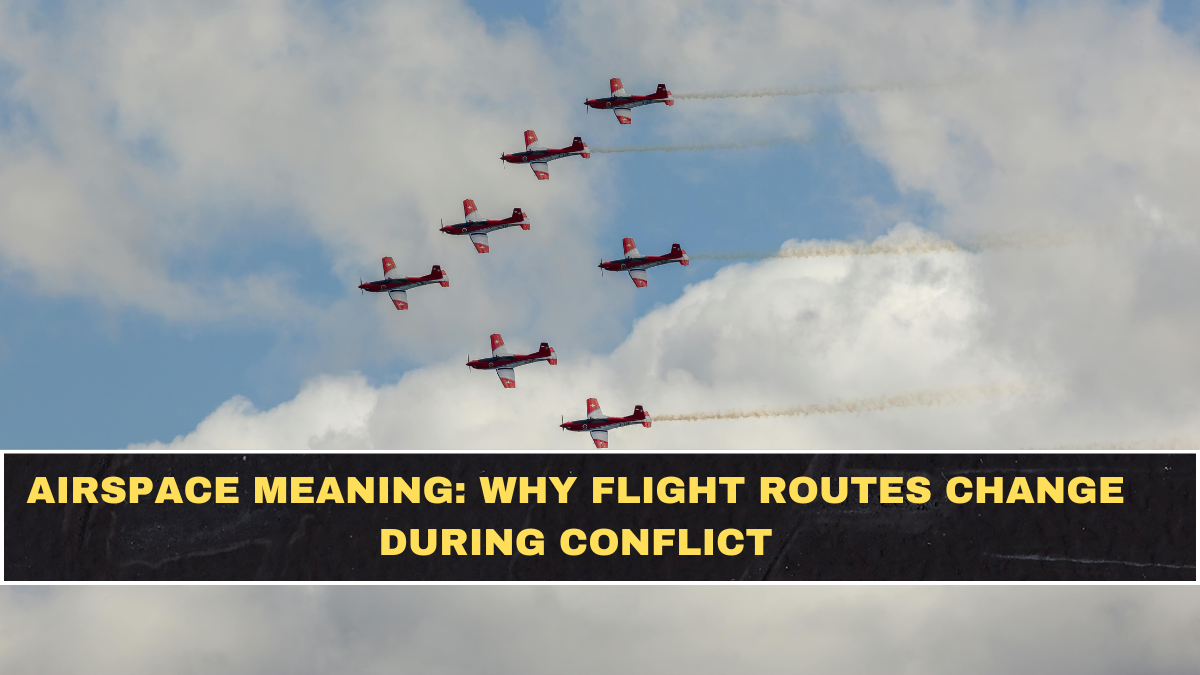
Airspace means the portion of sky controlled by a country or authority for aircraft movement. In Hindi, airspace can be understood as “हवाई क्षेत्र”, meaning the controlled sky area above a country, sea region or specific zone. Airlines cannot simply fly anywhere they want because every route needs permission, safety clearance and coordination with air traffic control.
This becomes important during wars, border tension, missile activity, security threats or military exercises. When a country closes its airspace or creates a restricted zone, airlines must avoid that area and choose a longer or safer route. That is why one conflict in West Asia, Russia-Ukraine region or South Asia can suddenly affect flight timings, fuel costs and ticket prices.
Why Do Countries Close Airspace?
Countries close or restrict airspace when they believe flying through that region may be unsafe. This can happen because of military conflict, missile risk, drone activity, air defence operations, political tension or emergency security decisions. Aviation regulators then issue route restrictions, alerts or NOTAMs so airlines can reroute flights safely.
India’s Ministry of Civil Aviation had earlier advised Indian carriers operating international services to continuously monitor airspace advisories, NOTAMs and route restrictions. Airlines were also told to ensure timely rerouting or diversion wherever required under global safety protocols, which shows how seriously airspace restrictions are treated.
| Term | Simple Meaning | Passenger Impact |
|---|---|---|
| Airspace | Controlled sky area used by aircraft | Decides where flights can legally fly |
| No-fly zone | Area where aircraft are not allowed | Flights must avoid the region |
| NOTAM | Official aviation safety notice | Airlines change routes or timing |
| Rerouting | Taking a different flight path | Longer journey and higher fuel use |
| Technical halt | Extra stop during long detour | More travel time and possible delays |
How Does Airspace Closure Affect Flights?
When airspace closes, flights are forced to take detours. A route that was earlier straight may become longer because the aircraft has to fly around the restricted region. This can increase flying time, fuel burn, crew duty time and operational cost. For passengers, the result can be delayed arrivals, longer flight duration, changed stopovers or higher fares.
The impact is not theoretical. Air India recently said it would temporarily suspend six international routes and reduce frequency on 22 others for June-August 2026 because of rising jet fuel prices and airspace restrictions linked to the Middle East conflict. This shows how airspace restrictions can move from aviation control rooms to ordinary passengers’ travel plans.
Why Do Ticket Prices Rise After Route Changes?
Airlines spend more money when flights become longer. Extra flying time means extra jet fuel, more crew planning, possible technical halts and tighter aircraft scheduling. Fuel is already one of the biggest airline costs, so a longer route can quickly make some flights less profitable. If the pressure continues, airlines may raise fares or cut weaker routes.
A 2025 study in Communications Earth & Environment found that conflict-related airspace restrictions increased average fuel consumption by around 13% on affected routes after detours. That is a serious cost increase, and passengers should not act shocked when airlines pass part of this cost into fares.
What Should Passengers Check Before Booking?
Passengers should stop assuming that international flight timing is fixed just because the ticket says so. During conflict or airspace disruption, airlines may change route, duration, layover or even suspend a route. Before booking, check whether the region you are flying over is affected by conflict, airspace restrictions or airline advisories.
Smart travellers should check:
- Latest airline advisory before booking or travelling.
- Flight duration changes compared with normal timings.
- Whether the flight has a new technical stop.
- Refund, rescheduling and cancellation policy.
- Layover time if connecting flights are involved.
- SMS, email and app alerts from the airline.
Is Airspace Closure Always Related To War?
No, airspace restrictions are not always caused by war. They can also happen because of VIP movement, natural disasters, rocket launches, military exercises, major public events or security operations. However, conflict-related airspace closures usually create the biggest international impact because they can affect long-haul routes across continents.
The blunt truth is that passengers usually notice airspace only when something goes wrong. Most people do not care about the route until the flight becomes longer, costlier or cancelled. But in modern aviation, airspace is as important as airports because a closed sky route can disturb thousands of flights.
Conclusion?
Airspace means the controlled sky area where aircraft are allowed to fly under official rules. During conflict, security threats or emergency restrictions, countries can close or limit airspace, forcing airlines to reroute flights. This can increase travel time, fuel costs, ticket prices and the chance of delays or route cuts.
For travellers, the lesson is simple: do not ignore aviation alerts when booking international flights. Check airline updates, understand route changes and keep flexibility in your plan. Airspace may sound like a technical word, but when it closes, passengers feel the impact directly.
FAQs?
What Is Airspace Meaning In Hindi?
Airspace meaning in Hindi is “हवाई क्षेत्र”. It refers to the controlled sky area above a country, region or specific zone where aircraft movement is managed by aviation authorities and air traffic control.
What Is A No-Fly Zone?
A no-fly zone is an area where aircraft are not allowed to fly due to security, military or safety reasons. Airlines must avoid such zones and choose alternate routes, which can increase travel time and fuel cost.
Why Do Flights Take Longer During Conflict?
Flights take longer during conflict because airlines avoid risky or closed airspace and use safer detour routes. These detours can add flying time, increase fuel use and sometimes require technical stops or schedule changes.
Can Airspace Closure Increase Ticket Prices?
Yes, airspace closure can increase ticket prices because longer routes cost airlines more in fuel, crew time and aircraft usage. If restrictions continue, airlines may raise fares, reduce frequency or suspend routes that become too expensive to operate.
Click here to know more