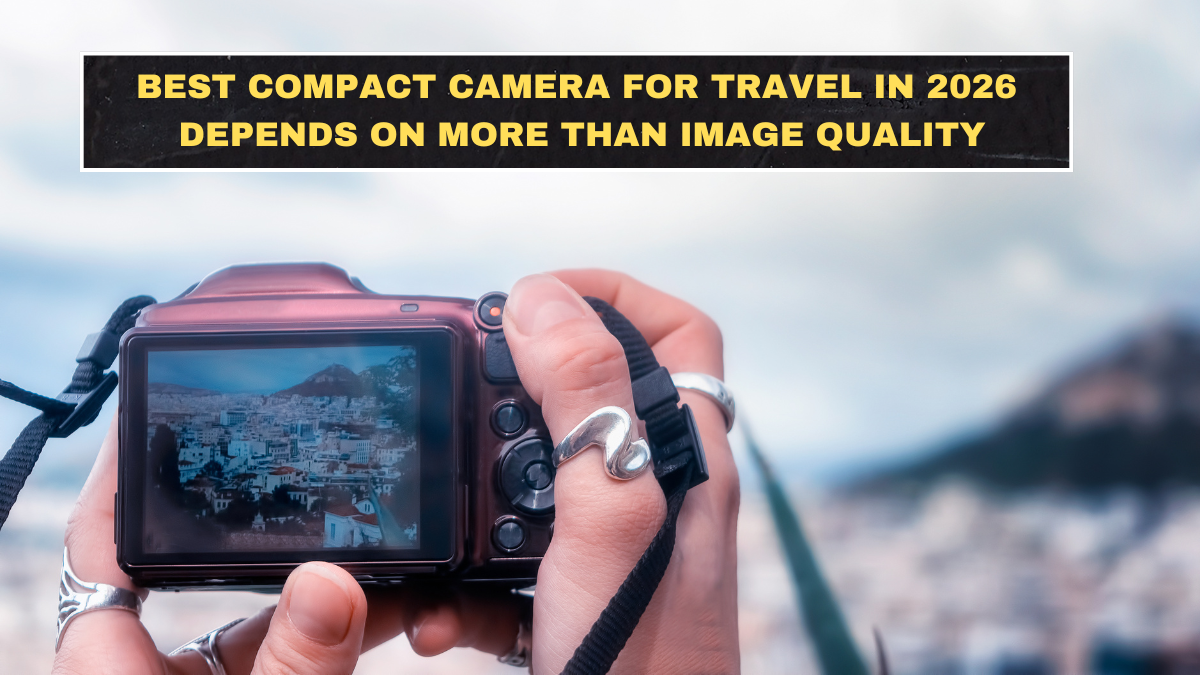
Travelers are coming back to compact cameras because phones still do not solve every travel problem well. The camera market data makes that clear. CIPA said built-in lens digital camera shipments reached 2,436,911 units in 2025, up 29.6% year over year, and it expects built-in lens cameras to rise again in 2026. CIPA also specifically tied demand to portability, convenience, zoom capability, video features, and image quality. That is basically the travel-camera checklist in one sentence.
This is the part lazy buying guides miss. Travel photography is not just about which camera produces the prettiest file in perfect conditions. Travel means airports, long walks, bad weather, limited bag space, tired hands, changing light, and spontaneous moments. A camera can have superb image quality and still be the wrong travel camera if it is too bulky, too delicate, or too annoying to carry all day. That is why the “best” compact travel camera in 2026 depends on the kind of traveler you are, not just on raw image quality.
What matters most in a travel compact camera?
The most important factors are portability, zoom range, durability, battery and charging convenience, and how quickly the camera fits the kind of travel you actually do. CIPA’s 2026 outlook explicitly highlighted portability and high-magnification zoom as key reasons built-in lens cameras are growing again. That matters because travel buyers often need one device that covers landscapes, street scenes, food, portraits, and distant subjects without a bag full of lenses.
This is where buyers fool themselves. They obsess over sensor size and forget daily usability. A premium fixed-lens compact may deliver beautiful files, but if it has no zoom and you keep wishing you could get closer to architecture, wildlife, or distant details, then its image quality advantage starts to matter less. On the other hand, a superzoom compact may give you huge reach, but if the sensor is small and the low-light performance disappoints, that tradeoff becomes obvious too. The smarter travel decision is matching the camera to the kind of trip, not to internet bragging rights.
Which travel compact cameras fit different types of travelers?
| Travel need | Best camera type | Why it fits |
|---|---|---|
| City breaks and creator-style trips | Canon PowerShot V1 / Sony ZV-1 II type compact | Better video tools, flip screens, larger sensor than basic zoom compacts |
| General travel with big zoom needs | Panasonic TZ99 or Canon SX740 HS type compact | Wide-to-long zoom range in a pocketable body |
| Rugged travel and adventure | OM System Tough TG-7 | Built for wet, rough, outdoor trips where fragile cameras are a liability |
| Minimalist photography-first travel | Fujifilm X100VI or Ricoh GR IIIx | Strong image quality and carry comfort, but less lens flexibility |
That table is the honest starting point. There is no single winner because these cameras solve different travel problems. Anyone telling you one compact camera is the best for every trip is either clueless or selling affiliate links instead of advice.
Is the best travel compact camera the one with the best image quality?
No, and this is where most people get the buying logic wrong. The Fujifilm X100VI is a great example. Fujifilm’s official specs show a 40.2MP APS-C sensor and advanced video features up to 6.2K/30p in a compact body, which makes it an outstanding image-quality and carry-everywhere camera. But it uses a fixed 23mm lens equivalent to 35mm full-frame, so you are locked into one focal length unless you crop or use conversion accessories. That is brilliant for some travelers and deeply limiting for others.
The same logic applies to the Ricoh GR IIIx. Ricoh positions it around a 40mm equivalent field of view, which many photographers love for natural-looking street and everyday scenes. But again, that is one fixed perspective. If your trip includes safari, wildlife, architecture details high above you, or even casual family travel where subjects change constantly, that elegance can turn into frustration fast. So yes, premium fixed-lens compacts can be the best for image-focused travelers. They are not automatically the best for travel overall.
Who should pick a zoom travel compact instead?
Zoom travel compacts make more sense for most ordinary travelers. Panasonic’s TZ99, for example, offers a 30x optical zoom, a 24mm ultra-wide starting point, 20.3MP sensor, 4K video, 5-axis hybrid stabilization, and a tiltable monitor in a pocket-sized body. Canon’s PowerShot SX740 HS takes a different route with a 40x optical zoom, 20.3MP sensor, 4K video, 5-axis stabilization, and a flip-up screen. Those are exactly the kinds of specs that make life easier on trips where you cannot predict what you will want to shoot next.
The downside is obvious: smaller sensors and more compromised low-light performance than premium large-sensor compacts. But that tradeoff is often worth it for travel. A travel camera that can go from wide city scene to distant temple detail to candid portrait without lens changes has real value. This is why CIPA keeps pointing to high-magnification zoom as a driver of built-in-lens camera demand. Travelers care about flexibility more than camera nerds like to admit.
What if you want travel video and not just photos?
Then video-focused compacts deserve more attention than the usual “best photo camera” picks. Canon’s PowerShot V1 is one of the clearest examples. Canon says it uses a large 1.4-inch sensor, an ultra-wide built-in lens, and a compact body aimed at content creation, while recent reviews note features like 4K up to 60p, mic and headphone jacks, and more advanced video tools than many older compacts. Sony’s ZV-1 II is another strong fit, with Sony calling it an all-round vlog camera with a 1.0-type sensor, wide-angle zoom lens, and built-in intelligent microphone.
That said, these cameras are not the answer for every traveler either. They make more sense for people who care about self-recording, better audio, flip screens, and short-form travel content. If your main need is long zoom for sightseeing or wildlife, they are weaker than proper travel zoom compacts. Again, the right answer depends on the trip, not on whichever model is currently trendy on YouTube.
When does a rugged compact make more sense than a “better” camera?
More often than buyers admit. The OM System Tough TG-7 is a good example because it is built around durability first, not luxury specs. OM System highlights macro capability, 4K video, GPS, USB-C, and the Tough line’s reputation for handling rough environments. For hiking, beach trips, wet climates, boat travel, or adventure travel where a fragile premium compact would make you nervous, a rugged camera can easily be the smarter travel camera even if the files are less impressive on paper.
This is where buyers make expensive mistakes. They buy a beautiful travel camera and then baby it so much that they stop using it in the situations where travel memories actually happen. A slightly worse camera you will confidently carry on a waterfall trail is worth more than a premium compact you keep zipped away because you are scared of damage.
Conclusion
The best compact camera for travel in 2026 depends on what kind of travel you actually do. If you want the most flexible all-around travel tool, a zoom compact like the Panasonic TZ99 or Canon SX740 HS makes more sense because travel often demands reach and versatility. If you care more about creator-style video and modern content tools, cameras like the Canon PowerShot V1 or Sony ZV-1 II are stronger. If you care most about image quality and a minimalist photography experience, premium fixed-lens compacts like the Fujifilm X100VI or Ricoh GR IIIx are excellent. If durability matters most, the OM System Tough TG-7 is the smarter pick.
The blunt answer is that image quality alone is not enough. The best travel camera is the one you will actually carry, trust, and use across the kinds of moments your trip will throw at you. Too many people buy for specs and forget they are buying for real life.
FAQs
Is a fixed-lens premium compact the best travel camera for most people?
Not for most people. It can be the best for travelers who care most about image quality and do not mind working with one focal length, but most ordinary travelers benefit more from zoom flexibility.
Are zoom compacts still worth buying in 2026?
Yes. CIPA’s 2026 outlook specifically pointed to portability and high-magnification zoom as reasons built-in lens cameras are growing, which is exactly why zoom compacts remain strong travel choices.
Which compact camera is best for travel video?
The Canon PowerShot V1 and Sony ZV-1 II are two of the stronger video-focused compact options because they combine larger sensors, flip screens, and creator-friendly video features in small bodies.
When is a rugged compact better than a premium compact?
A rugged compact is better when the trip involves water, dust, rough weather, or active outdoor use where durability matters more than chasing the prettiest image file.
Click here to know more