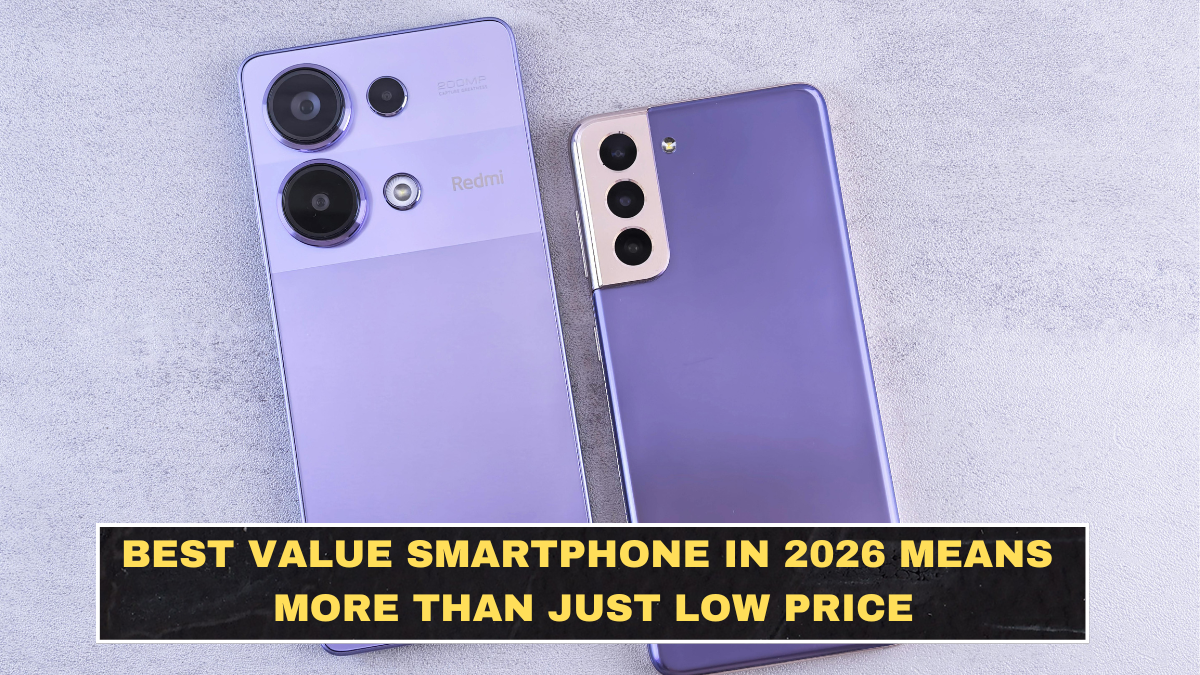
A cheap phone is not automatically a good-value phone. That is the mistake buyers keep making. In 2026, smartphone prices are under pressure, and even the global average selling price crossed $400 in Q4 2025, according to Counterpoint Research. So the real question is not “What is cheapest?” but “What gives the most useful life for the money?” That means looking at software support, battery size, repair durability, storage, and day-to-day speed instead of obsessing over one flashy feature.
The market already shows this shift. Recent mid-range picks highlighted by major reviewers include phones like the Google Pixel 9a, Samsung Galaxy A56 5G, and OnePlus 13R because they balance price with support and real usability, not because they pretend to be cheap flagships. Buyers are getting smarter, and they should, because marketing still tries to trick people into paying for specs they will barely use.
What actually makes a smartphone “best value” in 2026?
Value now comes from total ownership life, not launch price alone. A phone that gets long software support, has enough storage, strong battery life, and a good processor can stay useful for years. A cheaper device with weak update support or poor battery health may force an upgrade sooner, which makes it more expensive in practice. Samsung says the Galaxy A56 5G gets up to six generations of OS upgrades and six years of security updates, while Google positions the Pixel 9a as a lower-priced model with flagship-adjacent software features.
Performance matters too, but only to a point. Most buyers do not need top-tier benchmark numbers. They need a phone that stays smooth across messaging, camera use, maps, payments, and multitasking. OnePlus markets the 13R with Snapdragon 8 Gen 3, a 6,000mAh battery, and 120Hz display, which makes it a value case for power users. But that does not automatically make it the best value for everyone, especially if someone cares more about long updates or compact size than raw speed.
Which features should buyers compare first?
Start with five things: price, software support, battery, storage, and processor class. Camera quality matters, but it is often overused in ads because it is easier to sell than reliability. For many people, battery and updates will matter more after month six than a tiny difference in image sharpness. The Pixel 9a starts at $499 in the US and is listed at ₹39,999 on Google Store India, while Apple announced the iPhone 16e starting at $599 in the US. That gap matters, but only when compared against what each phone gives over three to five years.
| Model | Starting price | Value strength | Watch-out |
|---|---|---|---|
| Google Pixel 9a | $499 / ₹39,999 | Lower entry price, clean Google software | Not the fastest in class |
| Samsung Galaxy A56 5G | Varies by market | Long update policy, balanced features | Mid-range performance ceiling |
| OnePlus 13R | Market-dependent | Strong chip, 6,000mAh battery, fast charging | Less “value” if you do not need power |
| iPhone 16e | $599 | Lower-cost iPhone entry, Apple ecosystem access | Higher price than many Android value picks |
Prices and availability vary by region, but the pattern is clear: “best value” depends on buyer type, not one universal winner.
Why do buyers still get fooled by phone marketing?
Because brands sell excitement, not logic. They highlight AI tricks, camera buzzwords, peak brightness, and gaming claims because those are emotionally easier to market than update policy or battery longevity. But for most users, the better value phone is the one that still works well after two years with less lag, fewer battery complaints, and continued security support. That is also why mid-range models are winning more attention: people are tired of paying flagship money for incremental gains. Counterpoint’s recent India market note also pointed to demand pressure as rising memory prices weighed on sales in early 2026.
How should buyers decide which phone is best value for them?
Be honest about usage. If you mostly use WhatsApp, photos, YouTube, payments, maps, and social apps, you probably do not need a premium flagship. A Pixel 9a or Galaxy A56-type device may be the smarter buy. If you game heavily, edit video, or keep 100 apps open, then a OnePlus 13R-style performance phone may justify its price. If you want iOS but hate flagship pricing, the iPhone 16e exists exactly for that buyer.
Conclusion?
Best value smartphone in 2026 does not mean the lowest price. It means the best mix of useful life, support, battery, storage, and performance for your actual needs. Buyers who chase marketing usually overpay. Buyers who compare long-term value usually win. That is the difference.
FAQs
Is the cheapest smartphone the best value?
No. A phone with weak software support or poor battery life can cost more over time if it needs replacing sooner.
What matters more in 2026, camera or software support?
For most buyers, software support matters more over the long term because it affects security, features, and device life.
Is the Pixel 9a a value phone?
Yes, it is positioned as a lower-priced model with strong software appeal, starting at $499 in the US and ₹39,999 on Google Store India.
Who should consider the OnePlus 13R?
Users who care more about performance, battery, and charging speed than minimalist software or lowest entry price.