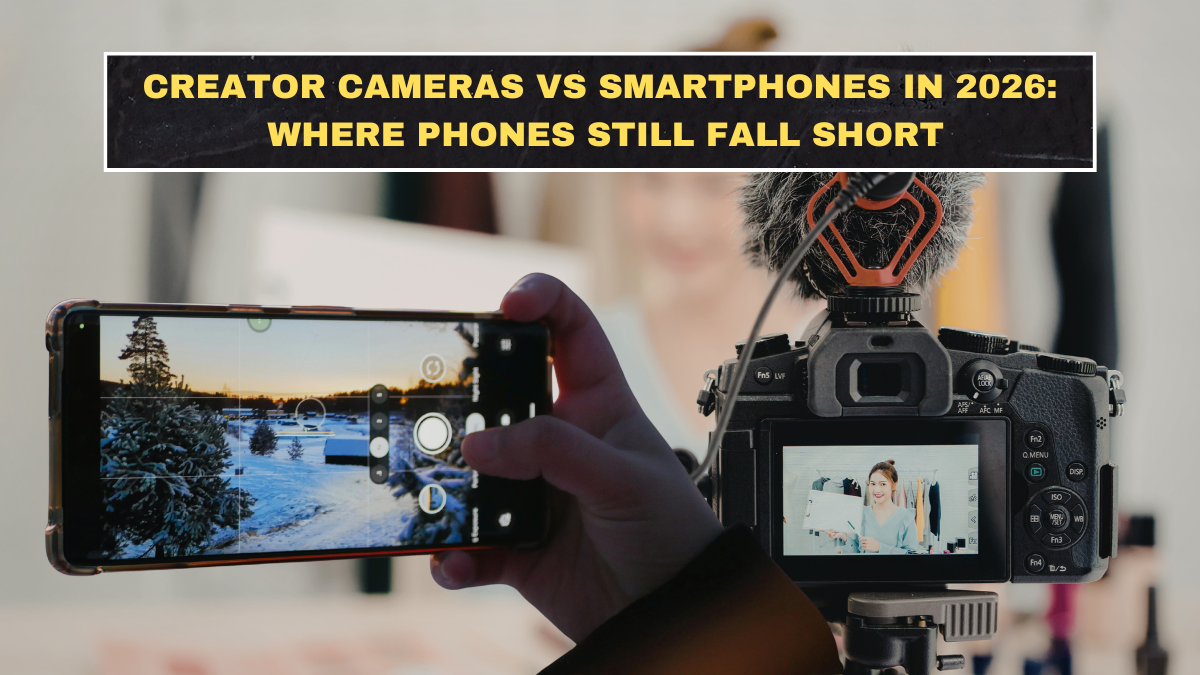
Smartphones still dominate because they are always in your pocket, fast to use, and tightly connected to editing and posting apps. But that convenience has not killed creator cameras. In fact, the compact camera category is growing again. CIPA reported that built-in lens digital camera shipments reached 2,436,911 units in 2025, up 29.6% year over year, and it expects them to rise again in 2026. That is not nostalgia alone. It is demand returning to a category that solves specific creator problems phones still handle badly.
The reason is simple. Once creators move beyond casual posting, the phone starts showing its limits. A phone is excellent for speed. It is weaker when lighting gets bad, when audio quality matters, when you need longer recording sessions, or when you want a more intentional look that does not feel like everyone else’s content. That is why brands are now launching creator-focused compact cameras instead of pretending the phone already does everything. Canon’s PowerShot V1 was explicitly launched as a content-creator camera, and Sony continues to position the ZV-1 II as an all-round vlog camera.
Where do smartphones still win for creators?
Phones still win on speed, simplicity, and distribution. You can shoot, edit, caption, and upload from one device in minutes. That matters because most creators do not fail from lack of sensor size. They fail from inconsistency. A phone removes friction, and friction kills output.
Phones also win when content is casual, reactive, and platform-native. If someone mainly shoots short talking clips, daily stories, quick behind-the-scenes posts, or trend-based content, the phone is often enough. The person who buys a camera before they have a real posting habit is usually fooling themselves. Better gear does not fix weak discipline. It just makes excuses more expensive.
Where do creator cameras beat smartphones most clearly?
The biggest edge is control. Creator cameras give better handling, better lens behavior, better audio options, and more reliable performance when conditions stop being easy. Canon says the PowerShot V1 uses a large 1.4-inch sensor, a built-in 16-50mm lens, and advanced autofocus, while Sony says the ZV-1 II pairs a 1.0-type sensor with an 18-50mm equivalent wide-angle zoom lens and an intelligent microphone. Those are not random spec-sheet bragging points. They directly affect how creator content looks and sounds in real use.
Low light is another obvious gap. Phones do a lot of computational correction, but that often creates an overprocessed look. Dedicated creator cameras usually hold up better when indoor light is messy, evening light is weak, or the creator wants more natural subject separation. The difference is not that phones are useless. It is that phones rely heavily on software rescue, while creator cameras start with better capture hardware. Canon is openly pitching the PowerShot V1’s larger sensor as a low-light advantage, and Sony makes the same quality argument around the ZV-1 II’s 1.0-type sensor.
What matters more for creators than image quality alone?
Audio, reliability, and workflow matter more than many creators admit. A crisp-looking video with weak sound still feels amateur. A camera that overheats or runs out of battery too fast becomes a problem on recording days. A setup that allows external mics, more stable handling, and longer shooting sessions can matter more than tiny differences in sharpness.
This is why creator cameras are not just “phones but better.” They are tools built around repeat use. Canon described the PowerShot V1 as a model for easy professional video and still shooting, while Sony keeps pushing the ZV-1 II as compact, portable, and built for vlogging. That framing matters because serious creators need tools that work predictably across many takes, not just one lucky clip.
Which creator setup makes more sense for which kind of content?
| Creator need | Smartphone | Creator camera |
|---|---|---|
| Fast daily posting | Stronger | Weaker |
| Shoot-edit-upload on one device | Stronger | Weaker |
| Better low-light quality | Weaker | Stronger |
| External audio and controlled setup | Weaker | Stronger |
| Longer-form vlogging or filming sessions | Mixed | Stronger |
| Travel-light casual content | Stronger | Mixed |
That is the real comparison. The phone is stronger when speed and convenience matter most. The camera is stronger when quality, control, and repeatability matter most. Anyone pretending one fully kills the other is thinking lazily.
Which creator cameras show this shift best in 2026?
Canon’s PowerShot V1 is one of the clearest signs that brands think creators want more than a phone now. Canon says it combines a 1.4-inch sensor, versatile 16-50mm lens, autofocus built for self-recording and moving subjects, and a compact body for content creators. That is a direct answer to the creator who wants better output without carrying a full interchangeable-lens setup.
Sony’s ZV-1 II sits in a similar lane. Sony describes it as a compact vlog camera with a wide-angle zoom lens, a 1.0-type sensor, and built-in intelligent microphone support. That makes it a strong example of what creators are actually buying now: not giant cinema rigs, but smaller dedicated cameras that outperform phones in the areas that start to matter once content gets more serious.
Should most creators upgrade from a smartphone to a camera?
Not immediately. Most creators should upgrade only when they can clearly name the phone’s failure point. If the problem is weak low-light video, bad audio flexibility, inconsistent blur, short battery life, or the need for more professional-looking footage, then a creator camera makes sense. If the real problem is inconsistent posting, weak ideas, or no audience clarity, then buying a camera is usually self-deception with a shopping cart.
That is the blunt truth many people avoid. Phones are still good enough for most beginner creators. Creator cameras matter when “good enough” starts costing you quality, credibility, or flexibility. That is why the category is rising again in 2026. Not because phones are failing overall, but because they still fall short in the exact places growth-minded creators start caring about.
Conclusion
Creator cameras are rising again because they solve problems smartphones still do not solve well. Phones remain unbeatable for speed, simplicity, and instant publishing. But once creators need cleaner low-light footage, stronger audio options, better lens behavior, and more reliable filming tools, dedicated cameras start making real sense. The market data and recent creator-camera launches both show that this is not a fake comeback. It is a practical one.
The smarter answer is not “phones versus cameras.” It is knowing when the phone stops being enough for the work you actually do. If your bottleneck is output discipline, keep using the phone. If your bottleneck is visual and production quality, a creator camera is no longer overkill. It is the next logical step.
FAQs
Do creator cameras really beat smartphones in 2026?
Yes, but only in specific areas. Creator cameras are stronger in low light, controlled video quality, lens behavior, audio flexibility, and longer-form recording. Smartphones still win on convenience and speed.
Is a creator camera worth it for beginners?
Usually not at first. Most beginners are better served by posting more consistently with a phone until they can clearly identify what the phone is limiting. Gear is not a substitute for output.
Which creator cameras are getting attention in 2026?
Canon’s PowerShot V1 and Sony’s ZV-1 II are two clear examples, because both are being marketed directly toward vloggers and content creators who want compact but more capable tools.
Why are compact creator cameras growing again?
Because built-in lens camera shipments rose sharply in 2025 and are projected to keep rising in 2026, showing that creators and consumers still see value in compact dedicated cameras.
Click here to know more