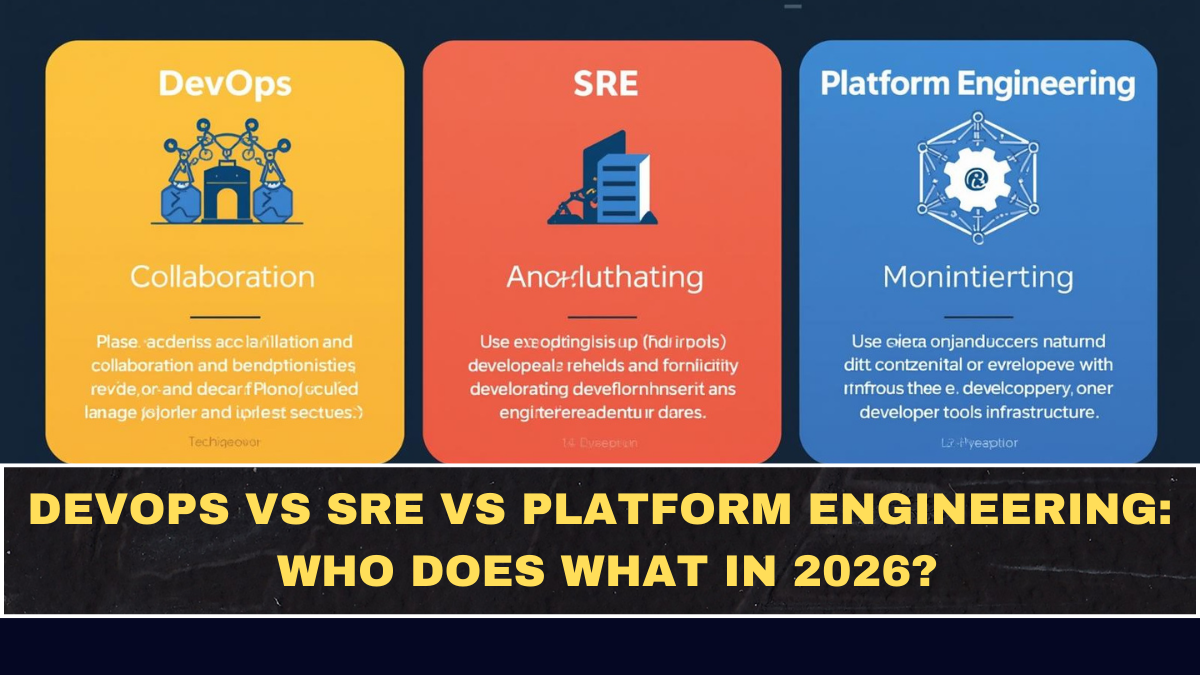
By 2026, many engineers are confused not because the industry is unclear, but because roles evolved faster than job titles. DevOps, Site Reliability Engineering (SRE), and Platform Engineering are often used interchangeably in hiring posts, yet they solve different problems. Understanding the real difference between these roles is critical, especially for engineers choosing a career path or teams structuring responsibilities correctly.
The confusion usually starts when companies treat these roles as replacements for each other. They are not. Each exists because software systems became larger, more distributed, and harder to manage. The overlap is real, but the intent behind each role is very different, and mixing them blindly leads to burnout and broken systems.
What DevOps Really Means in 2026
DevOps is not a job title by definition. It is a cultural and operational approach focused on collaboration between development and operations teams.
In practice, DevOps engineers often work on CI/CD pipelines, infrastructure automation, and deployment tooling. Their goal is to reduce friction between writing code and running it in production.
By 2026, DevOps has become the baseline expectation for modern engineering teams, not a specialized niche.
The Core Purpose of Site Reliability Engineering
SRE was created to answer one question: how reliable should a system be, and at what cost? It applies software engineering principles to operations and reliability problems.
SREs define SLIs, SLOs, and error budgets. They decide when to prioritize reliability work over feature delivery. Their focus is not speed alone, but controlled, predictable systems.
In 2026, SRE is strongest in systems where downtime is expensive or dangerous.
Why Platform Engineering Emerged Later
Platform engineering exists because DevOps tooling alone did not scale developer productivity. Teams still struggled with fragmented pipelines, inconsistent environments, and cognitive overload.
Platform engineers build internal developer platforms that standardize workflows and abstract complexity. Their focus is enablement rather than firefighting.
This role became prominent when companies realized that developer experience directly impacts business outcomes.
Key Differences in Daily Responsibilities
DevOps engineers often work closest to deployment pipelines and automation scripts. Their days involve improving release velocity and reducing manual steps.
SREs spend more time on monitoring, incident response, capacity planning, and reliability metrics. They are measured on stability, not features shipped.
Platform engineers focus on designing systems that other engineers use daily, treating internal tools as long-term products.
How Each Role Measures Success
DevOps success is often measured through deployment frequency, lead time, and failure rates. Faster and safer releases indicate healthy DevOps practices.
SRE success is measured through uptime, error budgets, and incident severity trends. Stability and controlled risk matter more than speed.
Platform engineering success shows up indirectly through faster onboarding, consistent deployments, and fewer support requests from developers.
Skill Sets That Overlap—and Where They Don’t
All three roles require strong automation skills and systems thinking. Understanding cloud infrastructure and scripting is foundational.
SREs need deeper expertise in observability, incident management, and reliability modeling. Platform engineers need stronger product thinking and UX sensitivity for internal users.
DevOps sits between the two, often acting as the bridge during transitions.
Why Companies Confuse These Roles
Many organizations lack maturity and assign all responsibilities to one team. This leads to vague titles like “DevOps/SRE Engineer.”
The confusion persists because outcomes are easier to measure than intent. Teams hire reactively instead of designing roles deliberately.
In 2026, mature companies separate these concerns clearly to avoid overload.
Which Role Pays More in 2026
Compensation depends on company scale and system criticality. SRE roles often pay more in high-availability environments.
Platform engineers command strong salaries in organizations with large engineering teams. DevOps pay remains competitive but more standardized.
Choosing a role based only on pay is short-sighted compared to long-term growth.
Which Role Should You Choose?
If you enjoy automation and cross-team collaboration, DevOps is a strong foundation. If you thrive under pressure and enjoy system reliability, SRE fits better.
If you like designing systems for other engineers and thinking long-term, platform engineering offers growing opportunities.
Your preference should align with how you like to solve problems, not just trends.
Conclusion: Different Roles, Same Goal
DevOps, SRE, and platform engineering all exist to make software delivery sustainable. They approach the problem from different angles.
Understanding these distinctions helps engineers build clearer career paths and helps companies avoid organizational chaos. In 2026, clarity around these roles is no longer optional.
The strongest teams know exactly who owns speed, who owns reliability, and who owns enablement.
FAQs
Is DevOps still relevant in 2026?
Yes, DevOps is foundational and expected across most engineering teams.
Can one person do DevOps, SRE, and platform work?
In small teams yes, but it does not scale well in larger organizations.
Is platform engineering only for big companies?
No, even mid-sized teams benefit from shared platforms and standards.
Do SREs write application code?
Yes, SREs often write code for automation, tooling, and reliability improvements.
Which role is best for beginners?
DevOps is often the easiest entry point due to its broad exposure.
Will these roles merge in the future?
They may overlap more, but their core goals will remain distinct.