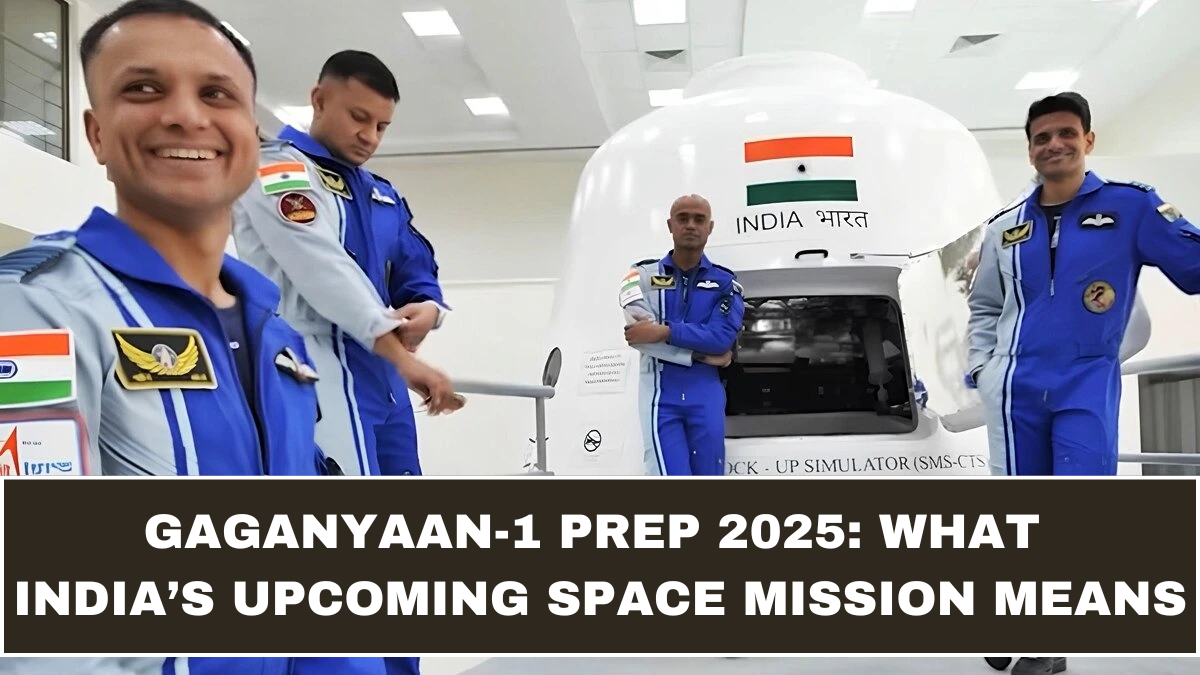
India is gearing up for one of its most ambitious space endeavors yet — Gaganyaan-1, the country’s first crewed space mission. Spearheaded by the Indian Space Research Organisation (ISRO), this mission aims to send Indian astronauts, known as Vyomnauts, into low Earth orbit. Scheduled for 2025, Gaganyaan-1 has captured national attention, not just for its scientific significance but also for its potential to place India among a select group of nations capable of human spaceflight.
The preparation for Gaganyaan-1 involves meticulous planning, cutting-edge technology, rigorous astronaut training, and extensive collaboration with international space agencies. This mission reflects India’s growing prowess in space science, a sector that has been rapidly advancing over the past two decades.
Why Gaganyaan-1 Is a Milestone for India
Gaganyaan-1 is more than just a technical mission; it is a statement of India’s scientific and technological capabilities. Key milestones include:
-
Sending Indian astronauts to space for the first time.
-
Testing human-rated spacecraft systems capable of sustaining life in orbit.
-
Demonstrating crew safety protocols, emergency escape procedures, and orbital maneuvers.
-
Strengthening India’s standing in international space collaboration.
For India, this mission is a leap from robotic satellite launches to human spaceflight, underscoring decades of progress in aerospace engineering and research.
Gaganyaan-1 Mission Objectives
The mission has several critical objectives:
-
Human spaceflight demonstration: Verify life support systems, crew safety, and orbital operations.
-
Scientific experiments: Conduct microgravity research and test space technologies.
-
Technological validation: Assess the performance of the crew module, launch vehicle, and recovery systems.
-
Global collaboration: Coordinate with space agencies for training, simulations, and safety protocols.
These objectives indicate that Gaganyaan-1 is not only a demonstration flight but also a stepping stone for future Indian space exploration, including potential lunar missions.
Training Indian Astronauts: The Vyomnauts
A significant part of Gaganyaan-1 preparation involves training the astronauts. Selected from Indian Air Force personnel, the Vyomnauts undergo rigorous training in both domestic and international facilities. Their preparation includes:
-
Physical and mental conditioning: Strength, endurance, and stress management training to withstand launch and microgravity conditions.
-
Simulations: Virtual reality modules to mimic orbital environments, emergency protocols, and spacewalks.
-
Survival training: Preparing for off-landing recovery in various terrains, including water and land scenarios.
-
Technical skills: Operating spacecraft systems, communication protocols, and scientific experiments.
This extensive training ensures that the crew is fully prepared for the challenges of spaceflight and can safely return to Earth.
Spacecraft and Launch Vehicle Development
Gaganyaan-1 will utilize India’s GSLV Mk III rocket, a heavy-lift vehicle capable of launching crewed modules into orbit. The mission’s crew module is designed to carry two to three astronauts and includes:
-
Life support systems for oxygen, temperature, and pressure control.
-
Safety mechanisms, including emergency escape systems for launch or in-orbit contingencies.
-
Avionics and control systems for navigation, communication, and monitoring crew health.
Testing these systems is a crucial part of the mission, ensuring that Gaganyaan-1 meets international safety standards for human spaceflight.
Technological Challenges and Innovations
Human spaceflight presents several technological challenges, from life support to re-entry dynamics. ISRO’s engineers are focusing on:
-
Heat shield technology for safe re-entry into Earth’s atmosphere.
-
Crew module design that ensures maximum safety and comfort in microgravity.
-
Autonomous systems to support crew operations in case of emergencies.
-
Telemetry and monitoring systems for real-time tracking of crew health and spacecraft status.
These innovations will not only support Gaganyaan-1 but also lay the groundwork for future Indian space missions, including potential orbital research stations.
Significance of Gaganyaan-1 for India and Beyond
Gaganyaan-1 has strategic, scientific, and inspirational value. For India, it:
-
Strengthens the country’s position among nations with human spaceflight capabilities.
-
Inspires a new generation of scientists, engineers, and space enthusiasts.
-
Boosts domestic aerospace research, manufacturing, and STEM education.
-
Provides opportunities for international collaboration in space science and exploration.
The mission embodies India’s vision of leveraging space technology for national development, scientific research, and global recognition.
Future Prospects After Gaganyaan-1
Gaganyaan-1 is just the beginning. ISRO plans subsequent missions to expand human spaceflight capabilities, including:
-
Longer-duration orbital flights.
-
Microgravity research labs for advanced scientific experiments.
-
Potential partnerships for lunar exploration and international missions.
These steps will position India as a significant player in the global space community, capable of both autonomous and collaborative human space missions.
Conclusion
The Gaganyaan-1 mission in 2025 represents a landmark achievement in India’s space history. It combines rigorous astronaut training, advanced spacecraft technology, and international collaboration to showcase India’s capabilities in human spaceflight. Beyond technical milestones, the mission inspires the nation and strengthens India’s scientific, technological, and strategic presence on the global stage. With the Vyomnauts ready for launch and spacecraft systems tested, Gaganyaan-1 will mark the beginning of a new era in India’s space exploration journey.
FAQs
What is Gaganyaan-1?
Gaganyaan-1 is India’s first crewed space mission, aiming to send Indian astronauts into low Earth orbit in 2025.
Who are the Vyomnauts?
Vyomnauts are the astronauts selected by ISRO for the Gaganyaan mission, trained in physical, technical, and survival skills for spaceflight.
Which rocket will launch Gaganyaan-1?
The GSLV Mk III, India’s heavy-lift launch vehicle, will carry the crew module into orbit.
What experiments will be conducted during the mission?
The mission will focus on microgravity research, space technology testing, and validation of life support systems.
Why is Gaganyaan-1 significant for India?
It establishes India as a human spaceflight nation, advances aerospace technology, and inspires scientific growth and international collaboration.