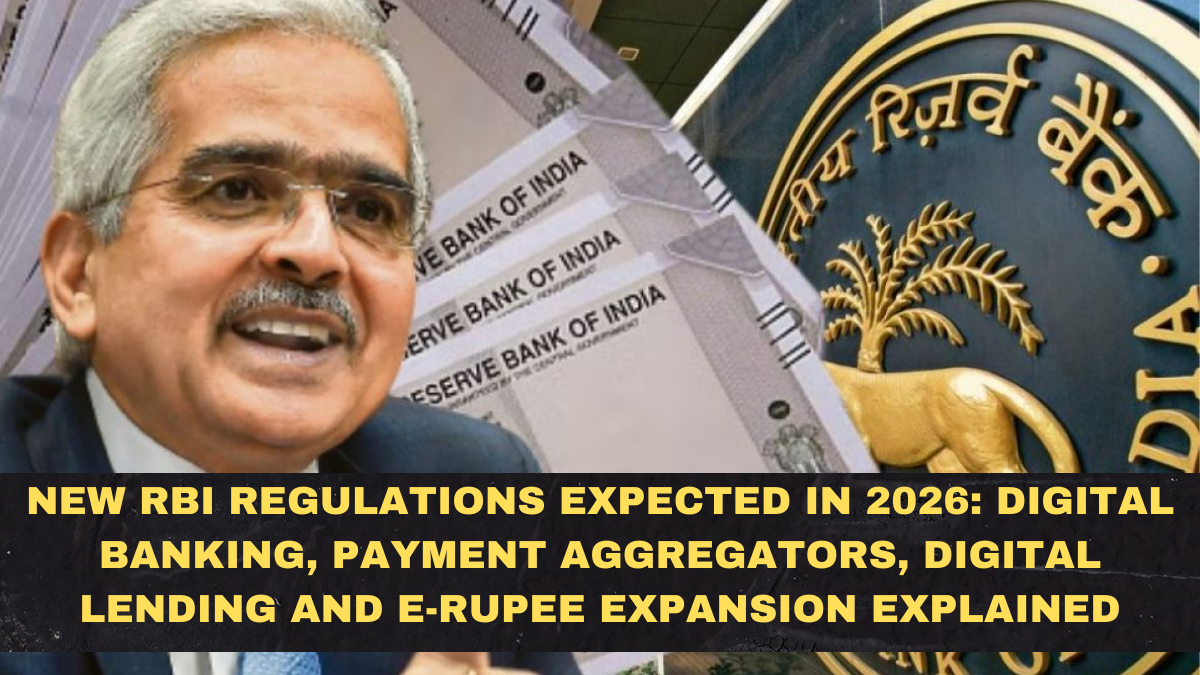
The RBI regulations expected in 2026 are not cosmetic rule tweaks. They represent a deep structural reset of how digital money, online lending, fintech apps, and even central bank digital currency will operate in India going forward.
Most people are missing what is really happening here.
This is not just about compliance or paperwork.
This is about control.
The RBI is drawing a hard boundary around who is allowed to touch Indian consumers’ money, how that money can move, how loans can be sold, and how digital payments will behave inside India’s financial system.
And in 2026, that boundary is tightening fast.
Why RBI Is Resetting Digital Banking Rules in 2026
The RBI is reacting to a decade of uncontrolled fintech expansion.
Over the last few years:
-
Payment apps exploded
-
Loan apps multiplied
-
BNPL products flooded the market
-
Data-sharing became messy
-
Consumer complaints surged
-
Fraud incidents spiked
The financial system became innovative.
It also became chaotic.
The RBI’s core concern is not innovation anymore.
It is consumer protection and systemic risk.
That is why the RBI regulations in 2026 are focused on tightening the entire digital finance stack.
The Real Problem RBI Is Trying to Solve
This is not ideological.
It is operational.
Three dangerous patterns forced RBI’s hand.
First, thousands of shady loan apps were exploiting users with hidden charges and harassment.
Second, payment aggregators were holding customer funds without clear liability rules.
Third, fintech companies were behaving like banks without being regulated like banks.
That combination is a financial accident waiting to happen.
So RBI’s 2026 regulatory reset is about pulling fintech back under formal banking discipline.
Digital Banking: What Is Changing in 2026
RBI wants to end the blurred line between banks and fintech apps.
Under the new regulatory direction:
-
Only licensed banks or tightly regulated NBFCs will be allowed to offer core banking services
-
Fintech apps will be treated as technology service providers, not pseudo-banks
-
Customer funds must sit only in regulated bank accounts
-
Data-sharing rules will become far stricter
This means most digital-only finance apps will lose operational freedom.
They will still exist.
But they will no longer be allowed to behave like mini-banks.
Why This Matters to Ordinary Users
This affects you directly even if you never think about RBI rules.
Because:
-
Your payment app
-
Your loan app
-
Your wallet app
-
Your BNPL app
All of them are about to become more restricted, slower, and more regulated.
That sounds boring.
It is actually good.
It reduces fraud, misuse, and harassment risk.
Payment Aggregators: The Biggest Regulatory Target in 2026
Payment aggregators are quietly becoming RBI’s main obsession.
Why?
Because they sit between:
-
Merchants
-
Customers
-
Banks
-
Card networks
They touch money without being full banks.
That makes them systemically dangerous.
Under RBI’s 2026 rules:
-
Payment aggregators must obtain full RBI authorization
-
Customer funds must be kept in escrow accounts
-
Settlement timelines will be strictly regulated
-
KYC and AML compliance will become mandatory
-
Data localization rules will be enforced harder
This will wipe out dozens of small payment gateway startups.
Only large, compliant players will survive.
What Happens to UPI Apps and Wallets
UPI apps are not being banned.
But they are being tightened.
Expect:
-
Stronger identity verification
-
Transaction-level fraud monitoring
-
Tighter limits on certain use-cases
-
Faster blocking of suspicious accounts
Wallets will face even harsher rules.
Many semi-closed wallets may shut down entirely.
The RBI does not trust wallet balances anymore.
Digital Lending: The Most Aggressive RBI Crackdown Area
This is where RBI is the angriest.
The digital lending ecosystem abused regulatory gaps brutally.
Hidden charges.
Harassment calls.
Fake agents.
Data theft.
Psychological pressure.
The RBI is determined to end this.
Under 2026 digital lending rules:
-
Loan apps cannot disburse or collect money directly
-
All loans must flow bank → customer → bank
-
Key Fact Statements (KFS) will be mandatory
-
Recovery behavior will be tightly monitored
-
Harassment complaints will trigger regulatory action
-
Data sharing will be restricted heavily
This will destroy the current shady loan app business model.
Good riddance.
What This Means for Borrowers
For consumers, this is massively positive.
Because:
-
Hidden charges will reduce
-
Interest transparency will improve
-
Harassment risk will fall
-
Fake loan apps will disappear
But approval will become slower.
Paperwork will increase.
Instant loans will become less instant.
That is the price of safety.
e-Rupee Expansion: RBI’s Quiet Power Play
This is the most underestimated part of RBI’s 2026 strategy.
The e-rupee is not just an experiment anymore.
It is becoming infrastructure.
The RBI is slowly positioning e-rupee as:
-
A settlement layer
-
A programmable money system
-
A compliance-friendly currency
In 2026, expect:
-
Wider merchant acceptance
-
Government payment integration
-
Welfare disbursement trials
-
Cross-border payment pilots
The long-term goal is obvious.
RBI wants sovereign digital money that bypasses private wallets.
Why RBI Really Wants e-Rupee to Succeed
This is not about technology.
It is about control and transparency.
e-Rupee allows RBI to:
-
Track money flows better
-
Reduce black money leakage
-
Enforce tax compliance
-
Control monetary transmission more precisely
This is central banking evolution.
Not crypto imitation.
How These RBI Regulations Will Change Fintech Behavior
Fintech companies in 2026 will no longer be wild startups.
They will become boring compliance-driven businesses.
Expect:
-
Slower product launches
-
More documentation
-
Less aggressive growth
-
More partnerships with banks
-
Fewer shady experiments
This will kill hype.
It will also kill fraud.
Who Wins and Who Loses From RBI’s 2026 Reset
Winners:
-
Consumers
-
Legitimate fintech companies
-
Regulated banks
-
Long-term financial stability
Losers:
-
Shady loan apps
-
Grey-area wallets
-
Unregulated payment startups
-
Growth-at-any-cost fintech founders
This is a cleansing cycle.
Not a growth cycle.
Why This Is Not Anti-Innovation
This is where most people misunderstand RBI.
This is not anti-fintech.
This is anti-chaos.
The RBI is not killing innovation.
It is killing regulatory arbitrage.
Big difference.
Real innovation survives regulation.
Scams do not.
What Ordinary Users Should Actually Do in 2026
This is the practical part.
If you use digital finance apps:
-
Avoid unknown loan apps
-
Read Key Fact Statements
-
Stick to major payment apps
-
Don’t keep large wallet balances
-
Be patient with slower approvals
Regulation will protect you.
But only if you stop chasing shortcuts.
The Psychological Truth About RBI’s 2026 Regulations
These rules feel restrictive.
They feel controlling.
They feel slow.
But they are restoring something that was quietly lost.
Trust.
Trust in digital money.
Trust in online loans.
Trust in fintech apps.
That trust collapse is why RBI had to intervene this aggressively.
Conclusion: What RBI’s 2026 Digital Banking Reset Really Means
The RBI regulations expected in 2026 are not optional housekeeping.
They are a structural reset of India’s digital finance system.
They will:
-
Reduce fraud
-
Kill shady loan apps
-
Strengthen payment safety
-
Slow down fintech growth
-
Expand e-rupee usage
This will feel painful in the short term.
It will feel boring.
It will feel bureaucratic.
But in the long term, it will make India’s digital financial system far safer, cleaner, and more stable.
And in 2026, that trade-off is absolutely worth it.
FAQs
Why is RBI tightening digital banking rules in 2026?
To reduce fraud, protect consumers, and control systemic risk in fintech.
Will loan apps be banned under new RBI rules?
Shady loan apps will disappear, but legitimate digital lenders will survive under stricter rules.
How will payment aggregators be affected?
They will need RBI authorization, escrow accounts, and full compliance with KYC and AML rules.
What is the e-rupee and why does RBI want to expand it?
It is RBI’s digital currency designed to improve transparency and monetary control.
Will digital payments become slower because of new rules?
Yes, slightly slower, but significantly safer.
Is RBI killing fintech innovation?
No. RBI is killing regulatory arbitrage and unsafe business models.