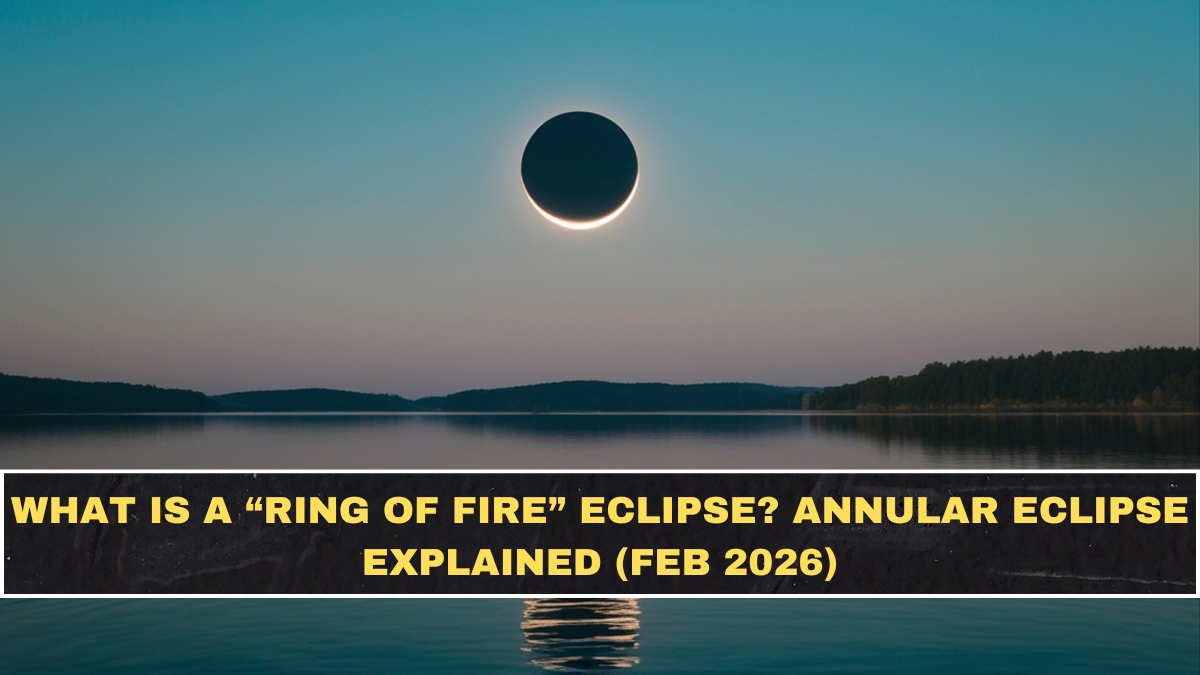
The phrase annular eclipse ring of fire sounds dramatic for a reason. It describes a solar eclipse where the Sun doesn’t go fully dark, and instead you see a bright, fiery-looking ring around the Moon. People hear “eclipse” and assume it means daytime turning into night everywhere, but this one works differently. It’s one of the most visually striking eclipse types, and also one of the easiest to misunderstand.
Most confusion comes from one simple mistake: people think an eclipse is a global show. It’s not. An eclipse is a geometry event, and your location decides what you see. So when you see “ring of fire,” the real question is not “Is it happening?” The real question is “Am I standing in the narrow strip of Earth where that ring is visible?”
What Does “Ring of Fire” Actually Mean?
A “ring of fire” happens during an annular solar eclipse. The Moon passes in front of the Sun, but it doesn’t fully cover it. Instead of a total blackout, a thin ring of sunlight remains visible around the Moon’s edge. That ring is the “fire” people talk about, and it looks like a glowing halo.
Why doesn’t the Moon cover the Sun completely? Because the Moon’s distance from Earth changes. When the Moon is farther away, it appears slightly smaller in the sky. If an eclipse happens during that time, the Moon can’t fully block the Sun’s disk, and the ring remains. That’s the entire concept, and it’s pure geometry—not mystery, not mythology.
Annular vs Total Eclipse: The Big Difference People Miss
In a total solar eclipse, the Moon fully covers the Sun and the sky darkens dramatically for a short time. In an annular eclipse, the Sun is never fully covered, so the sky does not go fully dark in the same way. It may look dimmer, the light may feel odd, but it won’t be that “night in daytime” moment.
This difference matters because it changes safety and expectations. During an annular eclipse, the Sun is still shining as a bright ring, which means eye safety is strict from start to finish. People get careless thinking “it’s covered, so it’s safe,” and that’s exactly how eye injuries happen. If you remember one line, remember this: annular is never “safe to stare at.”
Why Most People Won’t See the Ring Directly
The ring is only visible from a very narrow region called the annular path. Imagine a thin ribbon across the Earth where the alignment is perfect enough to see the full ring. Outside that ribbon, you may see a partial eclipse or you may see nothing at all. That’s why your friend in another country can post ring photos while your sky looks completely normal.
This is where viral posts mislead people. Social media makes it look like the “ring of fire” is everywhere, because photos spread faster than geography. But the event is location-limited by design. If you’re not in the annular path, you don’t get the ring—no matter how clear your sky is, and no matter how hard you “try.”
What You See If You’re Outside the Annular Path
If you’re outside the narrow annular path but still within the wider eclipse visibility region, you’ll see a partial eclipse. That means the Sun looks like a bite has been taken out of it, not a ring. The further you are from the path, the smaller that “bite” appears, until eventually it becomes unnoticeable.
Many people confuse partial visibility with “something went wrong.” Nothing went wrong. That’s the expected outcome. Partial eclipses can still be interesting, but they don’t create the iconic ring visuals people chase. So if your goal is the ring, your location has to match the path—simple as that.
Why It Was Trending So Hard in Feb 2026
The Feb 2026 event spiked searches because “ring of fire” is the most clickable eclipse phrase. It sounds rare, cinematic, and intense—so people want to know if they can watch it from their own rooftop. On top of that, a lot of posts mixed up timing and visibility, creating a second wave of confusion.
Another reason it trends is that people want certainty. They don’t want a science lesson—they want a yes/no answer: “Can I see it from India?” or “Can I see it from my city?” The internet often fails at giving that clarity quickly, so search spikes become massive. The phrase annular eclipse ring of fire becomes a shortcut people type when they want the straight story.
Safe Viewing Rules for an Annular Eclipse
Let’s be blunt: the Sun can damage your eyes permanently, and an annular eclipse does not reduce that risk enough to make casual viewing safe. Sunglasses are not protection. Phone screens are not protection. Random “hacks” like tinted film, CDs, or smoked glass are not protection. They reduce brightness, not harmful radiation.
If you’re in a place where you can see any phase of an eclipse, you need proper solar viewing filters designed for solar observation. And you need them the entire time you’re looking. The danger with eclipses is psychological: the Sun looks less intense, so you stare longer, and that longer exposure is what hurts you. Safety isn’t optional, it’s the whole game.
How to Watch Without Risk Even If It’s Not Visible for You
If the eclipse isn’t visible from where you live, the smartest move is to watch official live coverage or recorded streams instead of forcing a direct viewing attempt. People act like this is “less exciting,” but it’s actually better. Live feeds are taken with proper solar filters and camera setups, so you see more detail than your naked eye ever could.
Even if it is visible partially, you can still use indirect viewing methods like pinhole projection. That lets you see the eclipse shape safely without looking at the Sun. For families with kids, this is the best approach because it turns the eclipse into a safe learning moment instead of a risky stunt.
Common Myths That Spread During Every Eclipse
One myth is that cloud cover “ruined it” when the real issue is that the eclipse was never visible from that location. Another myth is that a phone camera is safe because you’re not “looking directly.” But when you aim at the Sun repeatedly, you still risk eye exposure while framing the shot, and you can also damage the camera sensor.
Another myth is that eclipses are visible everywhere if you know the “correct time.” Timing doesn’t override geography. If you’re outside the visibility region, the time window just tells you when the event is happening elsewhere on Earth. That’s why people feel confused: they expect the sky to change on schedule like a TV program. Nature doesn’t work like that.
Conclusion
The “ring of fire” is not a metaphor, it’s a precise visual effect that happens when the Moon appears slightly smaller than the Sun during an eclipse. The keyword annular eclipse ring of fire describes that exact moment: a bright ring of sunlight surrounding the Moon’s silhouette. But it’s not a worldwide show, and that’s the part most people refuse to accept until they’re disappointed.
If you want to approach eclipses like a smart person, you do two things: first, confirm whether your location is inside the annular path or at least in partial visibility. Second, follow strict viewing safety rules because the Sun remains dangerous even when it looks “dim.” Do those two things and you’ll avoid misinformation, avoid eye risk, and actually enjoy the event for what it is.
FAQs
What is an annular “ring of fire” eclipse in simple words?
It’s a solar eclipse where the Moon passes in front of the Sun but doesn’t fully cover it, so a bright ring of sunlight remains visible around the Moon.
Why don’t most people see the ring of fire directly?
Because the ring is only visible from a narrow strip on Earth called the annular path. Outside it, you may see a partial eclipse or nothing.
Is it safe to watch an annular eclipse with sunglasses?
No. Sunglasses are not designed for solar viewing and do not provide the required protection for safe eclipse viewing.
What do you see if you are outside the annular path?
You may see a partial eclipse where the Sun looks like a bite is taken out of it, or you may see no visible eclipse depending on your location.
What’s the safest way to watch if it’s not visible in my city?
Watch a live feed or recorded coverage, or use indirect viewing methods like pinhole projection if partial phases are visible and you have a safe setup.