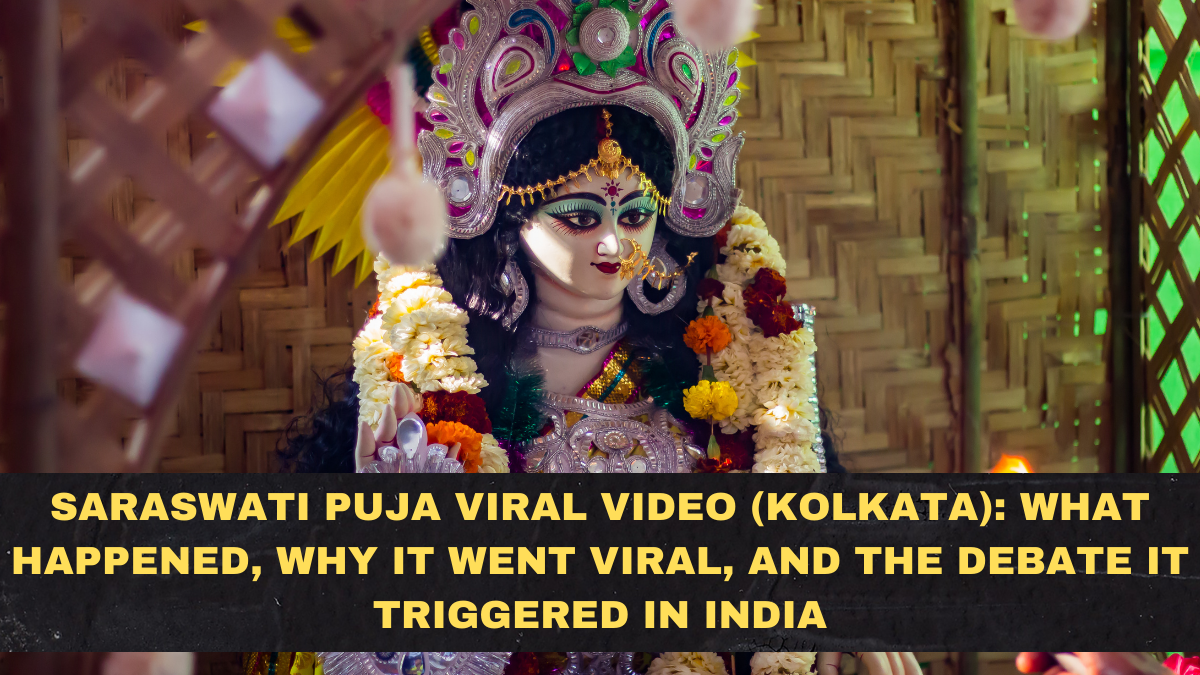
A short video clip recorded during Saraswati Puja celebrations in Kolkata unexpectedly turned into one of the most polarizing social-media flashpoints in India in Jan 2026. What began as a casual phone recording from a neighborhood pandal quickly exploded across Instagram, X, YouTube Shorts, and WhatsApp forwards, pulling millions of views within hours and triggering a nationwide debate that went far beyond the actual content of the clip.
The reason this video struck such a nerve was not because it showed anything criminal or obscene. It went viral because it sat exactly at the fault line between tradition and modern youth culture, between religious symbolism and performative social-media behavior, and between cultural pride and perceived disrespect. In a country where festivals are deeply emotional and identity-linked events, even a small visual moment can snowball into a national argument once it is algorithmically amplified.
This explainer breaks down what actually happened in the Saraswati Puja viral video from Kolkata, why it trended so aggressively, how different sides interpreted it in completely opposite ways, and what this incident reveals about India’s current social-media culture in 2026.
What Exactly Happened in the Viral Saraswati Puja Video
The viral clip was recorded at a local Saraswati Puja pandal in Kolkata during evening celebrations. It showed a group of college-age students dancing and recording reels near the idol and stage area while loud music played in the background. One of the girls in the group briefly performed a trendy Instagram dance step while holding a phone and smiling at the camera, with the idol visible in the background frame.
The clip itself was only about 12 seconds long. There was no vandalism, no physical disrespect toward the idol, and no offensive gestures. However, the visual composition of the scene — a devotional setting combined with a casual reel-style dance — was enough to trigger intense reactions once it was detached from its original context and circulated as a standalone moment.
Within a few hours, the video was reposted by multiple large meme and news-aggregation pages, often with captions implying that the students were “mocking” the festival or “disrespecting” Saraswati Puja.
Why the Video Went Viral So Fast
The speed at which this clip spread was not accidental. It matched three algorithmic triggers that dominate Indian social-media virality in 2026.
First, it involved a religious festival, which guarantees high emotional engagement and strong reactions. Second, it featured young people and a dance reel, which immediately connects it to influencer culture and youth behavior debates. Third, it created a moral ambiguity that forced viewers to take sides.
Platforms like Instagram and X heavily promote content that generates rapid comments, quote-posts, and duets. This clip did exactly that. People were not just watching it. They were arguing about it.
The more people argued, the more the algorithm pushed it to new users, creating a feedback loop where outrage itself became the distribution engine.
The Two Opposing Narratives That Emerged
Almost immediately, the internet split into two camps.
One side argued that the video showed blatant cultural disrespect. According to this group, filming dance reels near a Saraswati idol trivialized a sacred space and reflected a growing loss of cultural sensitivity among urban youth. Many users from this camp demanded legal action, public apologies, or institutional punishment for the students involved.
The other side argued that the outrage was manufactured. They pointed out that Saraswati Puja pandals in Kolkata have always been social spaces where people take photos, socialize, and celebrate. They argued that a harmless dance clip did not constitute disrespect and that selectively framing the moment as offensive was an overreaction driven by moral policing and clickbait captions.
Both sides were reacting to the same 12-second clip but interpreting it through completely different cultural and emotional lenses.
How Context Collapse Turned a Normal Moment Into a National Debate
The most important factor in this controversy was context collapse.
The clip was originally recorded as a casual reel inside a familiar social environment. Everyone present at the pandal that evening understood the vibe, the music, and the informal atmosphere. Once the clip left that environment and entered national social media, it lost all that context.
Viewers who had never attended a modern urban Saraswati Puja celebration saw only a freeze-frame of tradition colliding with Instagram culture. That visual collision alone was enough to trigger offense, even if no disrespect was intended.
This is a classic 2026 social-media pattern: ordinary moments become moral scandals when stripped of context and framed for outrage.
The Role of Meme Pages and Clickbait Captions
Another major accelerant was the way the clip was repackaged.
Many viral reposts added captions like “Is this how festivals are being respected now?” or “Disgusting behavior at Saraswati Puja in Kolkata.” These captions did more damage than the clip itself.
Once a video is paired with an outrage-triggering narrative, viewers no longer evaluate the content objectively. They consume it through the emotional filter provided by the caption.
This is why identical footage can generate completely opposite reactions depending on how it is framed.
Why This Incident Resonated So Deeply in 2026
This controversy did not explode only because of the clip. It exploded because it tapped into deeper anxieties that already exist in Indian society.
There is a growing generational tension around tradition versus modern self-expression. There is a rising frustration with influencer culture and performative behavior. There is also a heightened sensitivity around religious symbols being used in digital content.
This video became a symbolic battleground for all those unresolved tensions.
What Authorities and Organizers Actually Said
Local puja organizers in Kolkata clarified that no formal complaint was filed against the students and that no rules were violated inside the pandal. They stated that people regularly take photos, videos, and reels during puja celebrations and that there was no intention to disrespect the idol or the festival.
Police authorities also confirmed that no legal action was being taken, as there was no evidence of deliberate insult or public disorder.
These statements received far less attention than the outrage posts, which reveals how social-media narratives often overpower factual clarifications.
What This Tells Us About India’s Viral Culture in 2026
This incident is a textbook example of how Indian viral culture now works.
A short ambiguous clip appears. Meme pages frame it provocatively. Algorithms amplify it because of engagement. Public outrage builds. Context disappears. Real-world clarifications arrive too late.
The result is a moral controversy that feels massive online but barely exists offline.
Conclusion: A 12-Second Clip That Exposed a Much Bigger Cultural Fault Line
The Saraswati Puja viral video from Kolkata was never really about a dance reel near an idol. It was about how easily ordinary moments can be weaponized into moral controversies once they enter India’s outrage-driven social-media ecosystem.
Nothing illegal happened. No idol was harmed. No public disorder occurred. Yet millions of people were convinced that a serious cultural crime had taken place because a single clip was stripped of context and framed through emotionally loaded captions.
This episode exposes a deeper problem in 2026 India: social-media platforms are now better at amplifying anger than understanding. Every festival, every cultural ritual, and every public gathering is now one viral clip away from becoming a national controversy.
If anything positive can be taken from this incident, it is a reminder that digital outrage often says more about collective anxieties and algorithmic incentives than about the actual behavior being recorded. In a hyper-connected India, not every viral moment deserves a moral trial. Sometimes, it is just a moment that went too far, too fast, in the wrong digital direction.
FAQs
What is the Saraswati Puja viral video from Kolkata about?
It shows a group of students recording a short dance reel near a Saraswati Puja pandal, which later went viral and triggered a cultural debate online.
Did the students disrespect the idol or break any law?
No. Organizers and police confirmed that no rules were violated and no legal action was taken.
Why did the video go viral so quickly?
Because it involved religion, youth culture, and social-media behavior, which created strong emotional reactions and algorithmic amplification.
Why were people offended by the clip?
Some viewers felt that dancing near a religious idol was culturally inappropriate, especially when framed through outrage-focused captions.
What did puja organizers say about the incident?
They clarified that casual photos and videos during puja celebrations are normal and that there was no intent to disrespect the festival.
What does this incident reveal about social media in India?
It shows how context collapse, clickbait framing, and engagement-driven algorithms can turn ordinary moments into national controversies.