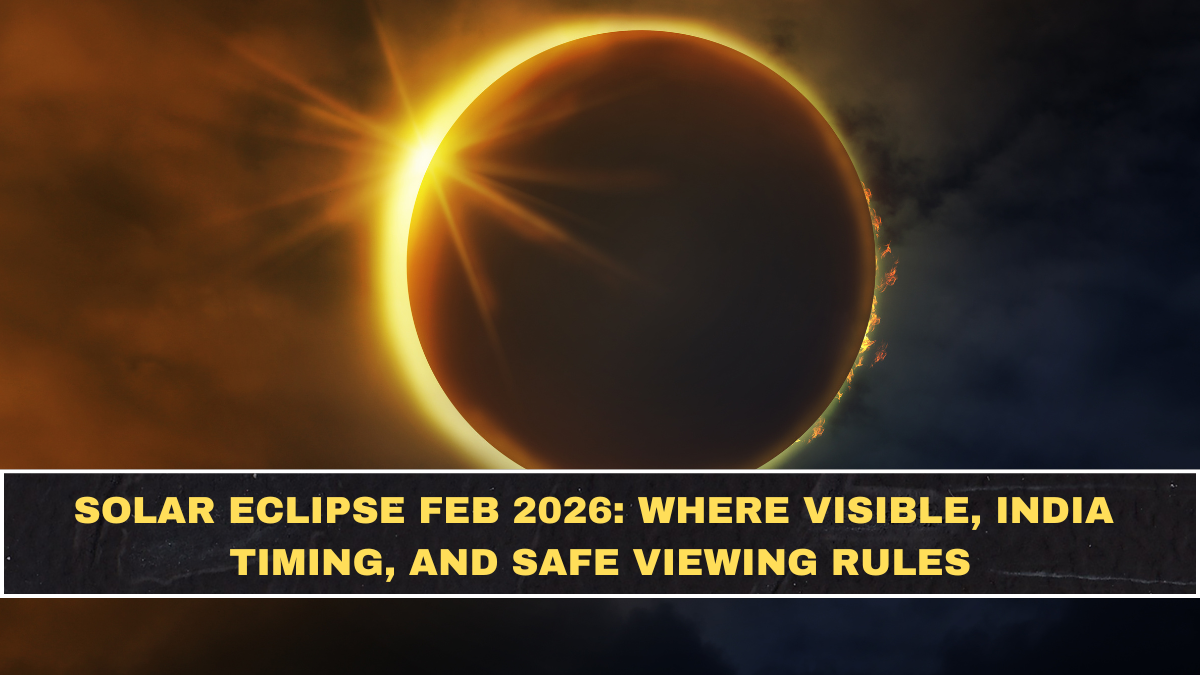
The solar eclipse Feb 2026 became a major search spike because it mixed two things people rarely see together: a dramatic “ring of fire” style eclipse and a lot of confusion about whether it could be watched from India. Most people don’t actually want astronomy lectures—they want one clear answer: “Can I see it from my city, and if not, what exactly should I do?” That’s what this guide is built for, with practical timing clarity and safety rules that won’t damage your eyes.
Here’s the clean reality: this eclipse happened as an annular solar eclipse, and it was not visible from India as a direct event. That doesn’t mean it wasn’t real, and it doesn’t mean people in India did something wrong—it simply means the eclipse’s visibility path didn’t cross India. What you can do in India is understand the timing window (in IST), know the safe viewing rules for any future eclipse viewing, and avoid the most common “fake hacks” that circulate every time.
What Actually Happened in the Solar Eclipse Feb 2026
This was an annular solar eclipse, which means the Moon passed in front of the Sun but didn’t fully cover it, leaving a bright ring around the edges for viewers standing in the right path. That “ring” effect is why it gets called a “ring of fire,” and it’s visually striking even in photos, so it naturally drives massive curiosity and social sharing.
The important detail is geography: an eclipse is not “visible everywhere.” It’s visible only where the Moon’s shadow falls in a way that lines up with your location. For this event, major coverage was over parts of the Southern Hemisphere and oceans, while India did not fall under the visible region for even a partial viewing. That’s why people in India couldn’t step outside and see a bite taken out of the Sun.
India Timing Window in IST (Even Though It Wasn’t Visible)
Even when an eclipse isn’t visible locally, people still search timings because they want to follow live coverage or understand the global window. For this eclipse, the overall event ran from 3:26 PM IST to 7:57 PM IST, based on the widely reported global start and end times converted to India time. That means the “eclipse window” overlapped with late afternoon and early evening in India.
The approximate peak phase for the eclipse globally was around 5:43 PM IST, again based on the published greatest-eclipse time converted to India time. Don’t treat the peak time as something you could “watch from India”—you couldn’t. Treat it as the moment global coverage, photos, and live feeds were most intense, which is why social media and search interest usually spikes around that period.
Where It Was Visible (Simple Explanation Without Map Confusion)
There are two visibility layers: the narrow “annular path” where the ring effect is visible, and the wider “partial eclipse region” where the Sun looks partially covered. For the annular ring effect, you must be inside that narrow path, otherwise you only see a partial eclipse—or nothing at all. This is where most people get misled because a viral post makes it sound like everyone will see a ring.
For this eclipse, visibility was associated with parts of the Southern Hemisphere and broad ocean regions, while India remained outside the visibility zone. So if you were in India, the correct approach was not “try harder,” but “don’t try direct viewing at all; follow official coverage if you’re curious.” That single decision protects your eyes and kills the scammy misinformation cycle.
Safe Viewing Rules (These Are Non-Negotiable)
Let’s be blunt: looking at the Sun directly—eclipse or not—can permanently damage your eyes. The danger is worse during an eclipse because the light looks “less intense,” so people stare longer and do more damage. This is exactly how people end up with eye injury while thinking they were being careful. The only safe way to view the Sun is with certified solar viewing filters designed for that purpose, not random hacks.
Do not use sunglasses, smoked glass, camera film, CDs, phone screens, water reflections, or “tinted plastic” tricks. Those hacks reduce brightness but do not block the harmful radiation properly, and they create a false sense of safety. If you don’t have proper solar viewing equipment, the safe option is indirect viewing methods like a pinhole projection setup, which lets you observe the eclipse image without staring at the Sun.
How to Watch If It Isn’t Visible Locally (Without Risky Behavior)
If an eclipse isn’t visible from your location, the smartest way to follow it is through professional live coverage or verified astronomy feeds. That gives you better views than you’d ever get with your naked eyes anyway. People keep doing the opposite—stepping outside, squinting, taking phone videos, and then spreading confusion when nothing appears. That’s not curiosity; it’s poor judgment.
If you want a family-safe approach: treat it like a science moment indoors. Watch the global coverage, explain what annular means, and show why “visibility depends on shadow paths.” This is a better learning moment than forcing a risky outdoor viewing attempt. Also, it prevents kids from copying viral “look at the Sun through this trick” nonsense.
Common Misconceptions That Spread Every Single Eclipse
One big myth is “if it’s happening today, it must be visible everywhere.” That’s false—eclipses are location-dependent, and many countries will see nothing even when the eclipse is real and significant. Another myth is “clouds blocked it,” which becomes a convenient excuse when the eclipse was never visible from your region in the first place. People use weather as a cover for misunderstanding geography.
Another repeated misconception is about timing: people assume “India timing” means “India visibility.” It doesn’t. India timing just tells you when the event occurred globally in your local clock format. Confusing timing with visibility is how misinformation spreads, and it’s also how scammers bait people with fake “live viewing passes” or shady products.
Conclusion
The clean takeaway is simple: the solar eclipse Feb 2026 was a real annular eclipse, but it wasn’t visible from India as a sky event. The correct action in India was to avoid direct viewing attempts, use the IST timing only for following global coverage, and treat safety rules as absolute, not optional. If you do want to watch any future solar eclipse from India, the right planning starts with verifying visibility for your exact city and arranging proper viewing protection.
Most people don’t get hurt because they’re unlucky—they get hurt because they trust shortcuts. Don’t be that person. If you don’t have certified solar viewing protection, do not look at the Sun directly, even for a second. Your eyes don’t “heal back” from this kind of damage, and no eclipse is worth that trade.
FAQs
Was the solar eclipse Feb 2026 visible in India?
No. It was not visible from India as a direct eclipse event.
What was the timing in India (IST) for the eclipse window?
The global eclipse window corresponded roughly to 3:26 PM IST to 7:57 PM IST, with the strongest global phase around late afternoon in IST.
What is an annular “ring of fire” eclipse in simple words?
It happens when the Moon covers the center of the Sun but appears slightly smaller, so a bright ring remains visible around it for viewers in the right path.
Is it safe to watch a solar eclipse with sunglasses or a phone camera?
No. Sunglasses and phone screens are not safe solar filters. Direct viewing can damage your eyes even if the Sun looks dim.
What is the safest way to view any solar eclipse?
Use certified solar viewing filters made for eclipse viewing, or use indirect methods like pinhole projection. If you don’t have proper protection, don’t look directly at the Sun.