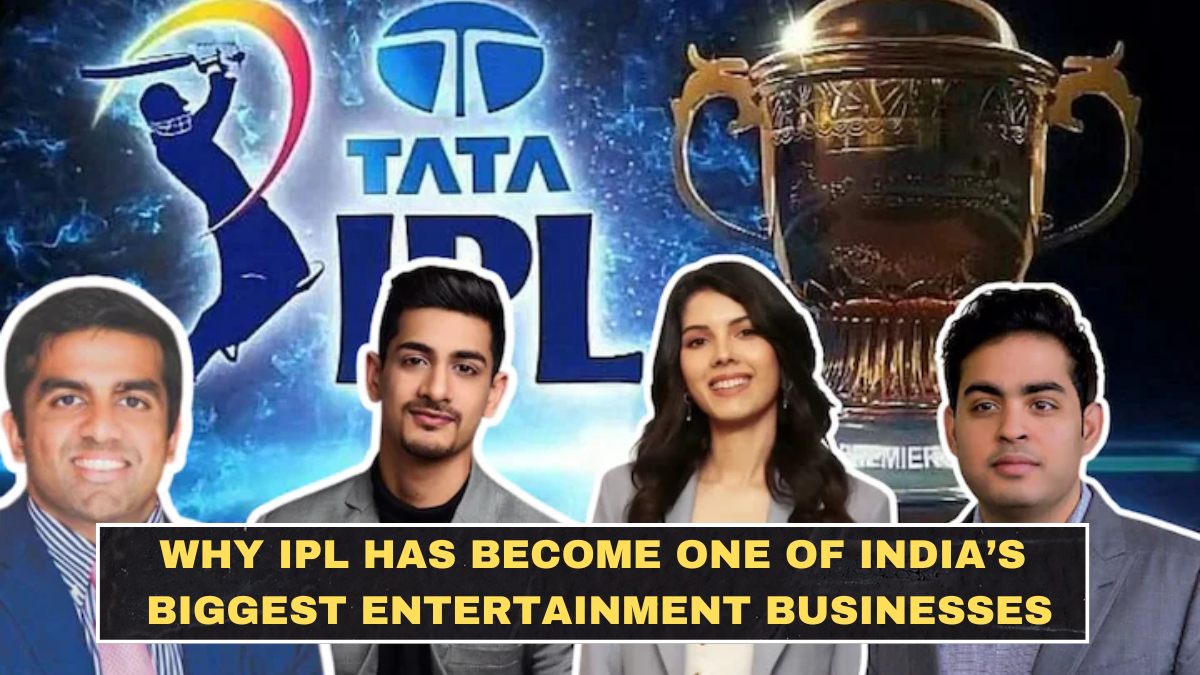
Calling the IPL just a cricket league is outdated. It is now one of India’s biggest entertainment businesses because it sits at the center of television, digital streaming, advertising, sponsorships, franchise valuations, and fan culture. Recent reporting said India’s sports economy crossed ₹18,864 crore in 2025, growing 13.4% year on year, and cricket accounted for about 89% of that total. That tells you the real story immediately: Indian sports business is still overwhelmingly a cricket business, and the IPL is the commercial engine inside it.
The IPL’s own financial scale is now hard to ignore. Reporting citing Houlihan Lokey said the league’s overall business value reached about $18.5 billion in 2025, while its standalone brand value was around $3.9 billion to $4 billion. That is why investor interest keeps rising and why the league is now discussed more like a premium sports-media asset than a seasonal tournament.

Media Rights Turned the IPL Into a Financial Machine
The strongest reason the IPL became such a huge business is simple: media money. Reuters reported this week that broadcasting rights for the league more than doubled to over $6 billion in 2022, helping fuel rising franchise revenues and investor appetite. Separate expert commentary in The Economic Times said Indian cricket derives around 80% of its revenue from media rights, which is far more concentrated than many global sports clubs that rely more heavily on matchday and commercial revenues.
That concentration matters because it explains why the IPL feels bigger than a normal tournament. It is not only selling tickets and attracting fans. It is feeding broadcasters, streaming platforms, advertisers, and franchise owners with a product that already has guaranteed national attention. In business terms, that makes the league much more powerful than a sport property that depends mainly on stadium turnout.
Advertising Keeps Making the League More Valuable
The IPL has also become an advertising juggernaut. The Economic Times reported yesterday that broadcaster JioStar had already locked in 27 sponsors for IPL 2026, with participation from big tech, FMCG, and legacy Indian brands. That matters because advertisers are not paying just for cricket inventory. They are paying for one of the few remaining mass-audience properties in India that still delivers scale, emotion, and repeat engagement over multiple weeks.
This fits the wider media economy too. The latest FICCI-EY reporting said India’s media and entertainment sector grew to ₹2.78 lakh crore in 2025, with digital advertising crossing ₹1 trillion and live experiences also gaining strength. In that environment, the IPL sits at a perfect intersection: it is sports, media, streaming, celebrity culture, and brand advertising all at once. That is why it keeps attracting money even when other parts of the ad market feel under pressure.
Franchise Culture Is Now Serious Big-Money Business
The league’s franchise side also shows how far the IPL has moved into the entertainment-business category. Reuters reported two days ago that Royal Challengers Bengaluru was sold to a consortium including Aditya Birla Group, Times of India Group, Blackstone, and David Blitzer’s family office for $1.78 billion. Reuters also said RCB’s revenue had climbed to $56 million in 2024–25, up 73% over three years. That is not hobby money. That is premium-asset behavior.
The sale also signals something bigger: global investors and major Indian business groups now treat IPL teams as serious long-term assets. And RCB is not the only indicator. Reporting citing Houlihan Lokey showed franchise values rising sharply across the league, with RCB, CSK, and MI all commanding very high business values. That is exactly what happens when a sports property stops being just an event and becomes a brand ecosystem.
Table: Why the IPL Has Become Such a Huge Business
| Business driver | Current evidence | Why it matters |
|---|---|---|
| Sports economy dominance | Cricket contributed about 89% of India’s ₹18,864 crore sports economy in 2025 | The IPL sits inside the country’s strongest sports revenue engine. |
| League valuation | IPL business value reached about $18.5 billion in 2025 | The tournament now behaves like a major media asset. |
| Media rights | Broadcast rights exceeded $6 billion in the 2022 cycle | Media cash transformed the league’s economics. |
| Sponsor demand | JioStar signed 27 sponsors for IPL 2026 | Brands still see the IPL as a top national attention platform. |
| Franchise value | RCB sold for $1.78 billion in March 2026 | Teams are now valuable investment assets, not just sports units. |
| BCCI dependence | Reporting said the IPL contributes roughly 59% of BCCI revenue | The league is the financial backbone of Indian cricket governance. |
The IPL Also Sells Fandom, Not Just Matches
Another reason the IPL became such a massive business is that it sells identity and habit, not only cricket. Team brands, player loyalty, memes, regional pride, fan parks, sponsors, fantasy play, and social-media conversation all help turn the tournament into a daily entertainment cycle. That matters because a league with recurring fan behavior is much more commercially powerful than a competition people watch only occasionally. This is partly an inference, but it is strongly supported by the way sponsors, broadcasters, and investors keep paying increasing amounts to stay inside the IPL system.
It also helps explain why the IPL feels closer to an entertainment franchise model than a traditional sports league. The value comes from the full ecosystem: broadcast, streaming, team brands, advertiser demand, and fan attention across multiple formats. That makes it more resilient than a simple tournament that depends only on on-field performance.
Why This Matters for India’s Media Business
The IPL matters beyond cricket because it has become a pillar of India’s wider media economy. When one property can command billion-dollar rights deals, premium sponsor demand, and billion-dollar franchise transactions, it shapes how media companies think about sports, streaming, and advertising strategy. The IPL is no longer just participating in India’s entertainment market. It is helping define it.
That is also why the league keeps attracting more sophisticated money and more commercial experimentation. Investors are not chasing sentiment. They are chasing a proven machine with scale, emotion, and recurring national relevance. That is rare, and rare attention is expensive.
Conclusion
The IPL has become one of India’s biggest entertainment businesses because it now operates as far more than a cricket event. It dominates the country’s sports economy, commands enormous media-rights money, attracts deep sponsor demand, and supports franchise valuations that look more like premium global sports assets than ordinary domestic teams.
The blunt truth is this: the IPL is not successful merely because Indians love cricket. It is successful because the league has turned that love into a scalable business system. That is why it keeps getting bigger, and that is why it now belongs in the conversation about India’s biggest entertainment industries, not just its biggest sports tournament.
FAQs
How big is the IPL as a business in 2025?
Recent reporting citing Houlihan Lokey said the IPL’s overall business value reached about $18.5 billion in 2025.
Why is the IPL so important to India’s sports economy?
Because cricket contributed about 89% of India’s sports economy in 2025, making the IPL the strongest commercial property inside that system.
How important are media rights to the IPL?
They are central. Reuters reported that IPL broadcast rights more than doubled to over $6 billion in the 2022 cycle, and commentary in The Economic Times said Indian cricket gets around 80% of its revenue from media rights.
Why are IPL teams becoming so valuable?
Because they now combine media revenue, sponsorship potential, brand strength, and fan loyalty. The clearest recent example is RCB’s reported $1.78 billion sale in March 2026.