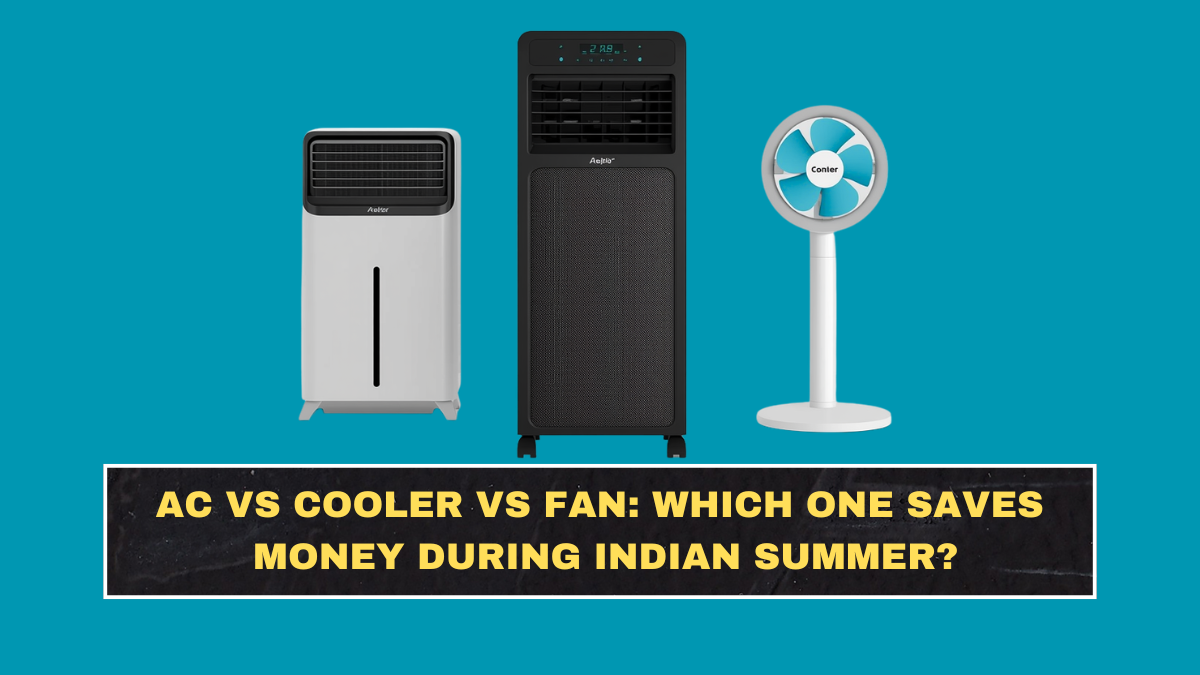
AC vs cooler vs fan is trending because large parts of India are already facing harsh summer conditions, and electricity bills are becoming a real concern for households. Rajasthan recently saw Sriganganagar touch 44.5°C, while parts of Punjab, Haryana, Jharkhand and Kerala also faced heatwave alerts or extreme-heat warnings. When temperatures move above 40°C, normal fan cooling starts feeling useless for many homes.
The real question is not only “which one cools better?” The better question is: which one gives enough comfort without destroying the monthly electricity bill? A fan is cheapest but limited. A cooler is affordable in dry heat but weak in humid weather. An AC gives the best cooling but can become the biggest electricity expense in the house if used carelessly.
Which Option Uses The Least Electricity?
A ceiling fan uses the least electricity, followed by an air cooler, while an AC uses the most. A standard ceiling fan may use around 75 watts, while a BLDC energy-saving fan can use around 28 watts. A desert cooler may use around 185 watts, while a 1.5-ton inverter AC can easily use around 945 watts to 1,200 watts depending on star rating and conditions.
This means the cost difference is not small. If all three are used for 8 hours daily, the fan may add only a small amount to the bill, the cooler may add a moderate amount, and the AC can add hundreds of units in a month. One AC used badly can cost more than several fans running together.
| Cooling Option | Typical Power Use | 8 Hours Daily Monthly Units | Approx Cost At ₹8/Unit | Best For |
|---|---|---|---|---|
| BLDC fan | 28W | Around 7 units | Around ₹56 | Low-cost airflow |
| Standard ceiling fan | 75W | Around 18 units | Around ₹144 | Basic summer use |
| Desert cooler | 185W | Around 44 units | Around ₹352 | Dry heat areas |
| 1.5-ton 5-star inverter AC | Around 945W | Around 227 units | Around ₹1,816 | Strong cooling |
| 1.5-ton 3-star inverter AC | Around 1,200W | Around 288 units | Around ₹2,304 | Cooling with higher bill |
Is A Fan Enough During Indian Summer?
A fan is enough only when the room temperature is not extremely high and the air is not too hot. A fan does not actually cool the air. It only moves air across the body, helping sweat evaporate and making you feel slightly cooler. That works well in mild heat, but during a heatwave, a fan may simply circulate hot air.
This is where many people fool themselves to save money. If the room is dangerously hot, especially for children, elderly people or anyone with health problems, relying only on a fan can be risky. A fan is the cheapest option, but cheapest is not always safest. During extreme heat, comfort and health matter too.
When Does A Cooler Make More Sense Than AC?
A cooler makes more sense than AC in dry regions where humidity is low. Places in Rajasthan, Haryana, Delhi-NCR and parts of central India often get dry heat, where evaporative cooling can work well. Coolers use water evaporation to reduce air temperature, so they need ventilation and airflow to perform properly.
But coolers perform badly in humid regions. In places with high humidity, adding more moisture to the air can make the room feel sticky and uncomfortable. That is why a cooler may feel useful in Jaipur but disappointing in coastal cities like Mumbai or Chennai. Buying a cooler without thinking about humidity is a common mistake.
Why Is AC The Most Comfortable But Most Expensive Option?
AC is the most comfortable because it reduces room temperature directly and also controls humidity. That makes it far more effective during intense heat, humid weather and night-time discomfort. During severe heatwaves, AC can protect sleep quality, productivity and health better than fans or coolers.
The cost problem is serious, though. AC Bill Calculator India notes that a 1.5-ton AC can typically consume around 300 to 360 units per month when used for 8 hours daily, costing around ₹2,100 to ₹2,500 per month at ₹7 per unit. Actual cost can be higher in expensive electricity slabs, especially because many AC users fall into higher consumption brackets.
How Much Can Star Rating Change AC Bills?
Star rating can change AC bills meaningfully, especially if the AC runs daily for long hours. A 1.5-ton 3-star AC may consume around 1,550 units per year, while a 1.5-ton 5-star AC may consume around 1,050 units per year under BEE-style annual usage assumptions. That difference of around 500 units can save about ₹4,000 per year at ₹8 per unit.
However, do not buy a 5-star AC blindly if you use AC only occasionally. The higher purchase price makes sense mainly when usage is heavy. If you use AC daily for 6–8 hours in summer, better efficiency matters. If you use it only a few nights per month, the payback may be slower.
Which Option Is Best For Different Indian Homes?
The best option depends on city climate, room size, budget and family health. A fan is fine for low-heat days or well-ventilated rooms. A cooler is best for dry heat and budget-conscious families. An AC is best for extreme heat, humidity, poor ventilation and vulnerable family members.
For many Indian homes, the smartest setup is not choosing only one option. Use a fan with AC at 24°C to 26°C to spread cool air faster. Use a cooler in dry afternoon heat if humidity is low. Use curtains, roof insulation, cross-ventilation and shaded windows to reduce heat entry. Cooling cost is not only about the appliance; it is also about how badly the room traps heat.
How Can You Reduce Electricity Bill While Staying Cool?
Set the AC temperature around 24°C to 26°C instead of 18°C. Every unnecessary degree lower makes the compressor work harder. Clean AC filters, close doors properly, block direct sunlight and use a fan with the AC. These basic habits reduce waste without sacrificing much comfort.
For coolers, clean the cooling pads, keep enough ventilation and change water regularly. For fans, consider BLDC models if fans run most of the day. A BLDC fan can use much less power than a standard fan, which matters in homes where multiple fans run for long hours. Small savings become real savings when summer lasts for months.
Conclusion?
AC vs cooler vs fan is not a one-answer question. A fan is the cheapest, a cooler is the best budget cooling option for dry heat, and an AC gives the strongest comfort but adds the biggest electricity cost. During heatwaves, the right choice depends on temperature, humidity, health needs and how many hours you use the appliance daily.
The blunt answer is this: use a fan when heat is manageable, use a cooler when the climate is dry, and use AC when heat or humidity becomes genuinely uncomfortable or unsafe. But do not run AC carelessly. Smart temperature settings, star rating, room insulation and fan support can decide whether summer cooling stays affordable or becomes a painful electricity bill.
FAQs
Which Is Cheapest To Run, AC, Cooler Or Fan?
A fan is the cheapest to run, followed by a cooler, while an AC is the most expensive. A standard fan may cost only a small amount per month, while a 1.5-ton AC can add hundreds of units if used daily.
Is Cooler Better Than AC For Electricity Saving?
Yes, a cooler uses far less electricity than an AC. However, it works best in dry climates. In humid areas, a cooler may feel uncomfortable because it adds moisture to the air.
What AC Temperature Saves Electricity?
Keeping the AC around 24°C to 26°C usually saves more electricity than setting it at 18°C or 20°C. Using a fan with the AC can also spread cool air faster and reduce compressor load.
Is A BLDC Fan Worth Buying?
A BLDC fan can be worth buying if fans run for long hours every day. It consumes much less electricity than a normal ceiling fan, so the savings become useful over a full summer season.