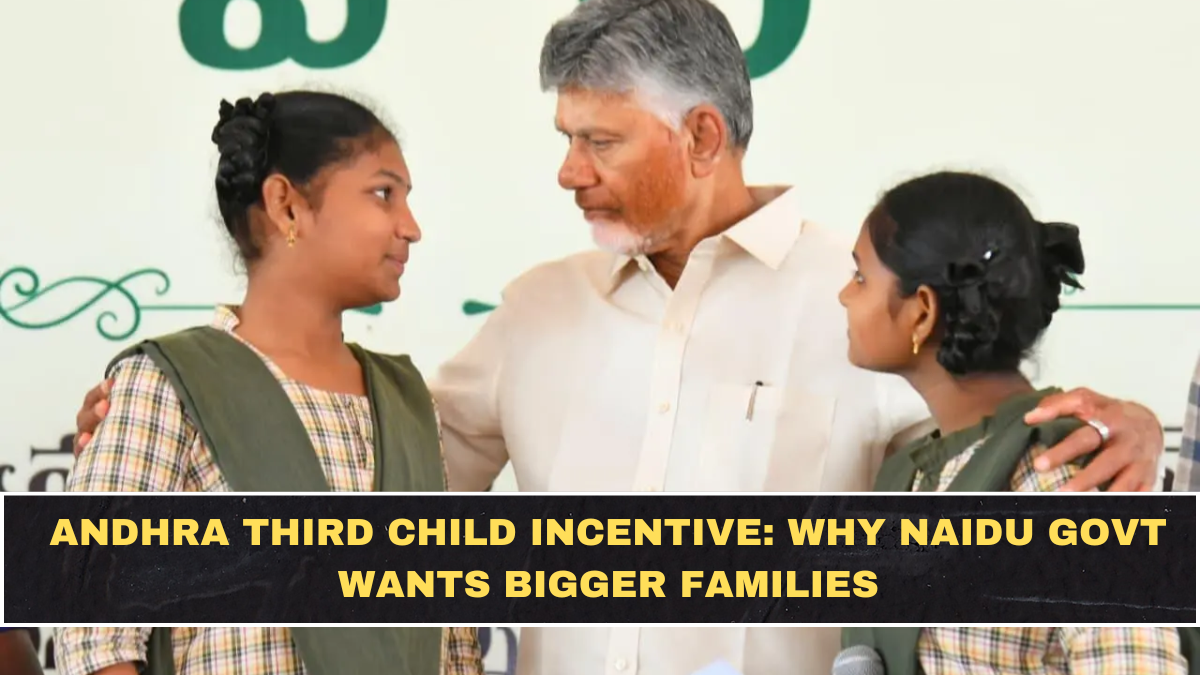
Andhra Pradesh Chief Minister N. Chandrababu Naidu has announced a cash incentive of ₹30,000 for the birth of a third child and ₹40,000 for a fourth child. The announcement has quickly become a major political and social talking point because it marks a clear shift from old population-control thinking to a new concern over declining fertility and ageing population.
The scheme is being projected as part of a broader population-management approach, but the final operational rules still need to be watched carefully. Indian Express reported that Naidu said further details would be announced within a month, which means families should not assume every eligibility condition is already final.
What Has Been Announced?
The announced incentive is simple on paper: ₹30,000 after the birth of a third child and ₹40,000 after the birth of a fourth child. Reports say Naidu made the announcement during a public programme and framed children as long-term wealth for society, while expressing concern over falling population growth.
| Child Birth | Proposed Incentive | Current Status |
|---|---|---|
| First child | No new incentive announced | Not part of this update |
| Second child | No new incentive announced | Not part of this update |
| Third child | ₹30,000 | Announced by CM |
| Fourth child | ₹40,000 | Announced by CM |
| Detailed rules | Awaited | Expected later |
This table shows why the announcement is attracting attention. It does not reward smaller families; it specifically encourages families to consider a third or fourth child. That is a bold policy signal, and it will naturally create debate around welfare, women’s health, household costs and state finances.
Why Is Andhra Worried?
The government’s concern is linked to declining fertility and future ageing. Reuters reported that India’s total fertility rate fell to 2.0 during 2019–2021 from 3.4 in 1992–1993, mainly due to higher contraceptive use and female education. The broader worry among some policymakers is that fewer births today may create a more ageing society tomorrow.
But this is where the debate becomes uncomfortable. India still has a massive population and serious employment pressure, so simply encouraging larger families is not automatically a smart solution. A child incentive makes sense only if the state can also support education, healthcare, jobs and women’s economic participation.
What Are The Big Questions?
The biggest question is whether a one-time cash payment can actually change family decisions. Raising a child costs far more than ₹30,000 or ₹40,000, especially when families consider schooling, healthcare, nutrition, housing and long-term career opportunities. If the policy is only symbolic, its real impact may be limited.
Important questions still need clarity:
- Who will be eligible for the incentive?
- Will income limits or category rules apply?
- Will the money go to the mother or family account?
- Will health and nutrition support be linked?
- How will the scheme prevent misuse or fake claims?
- Will women’s consent and welfare be protected?
These questions matter because population policy cannot be reduced to a cash transfer. If families are pushed toward more children without stronger social support, the burden may fall hardest on women, low-income households and already stretched families.
Can Cash Reverse Birth Decline?
Cash incentives can create attention, but they rarely solve fertility decline alone. Countries facing ageing populations often use a mix of childcare support, parental leave, housing help, tax benefits, women-friendly workplaces and healthcare support. Reuters also noted that other regions, including Sikkim, have used measures such as maternity and paternity benefits and IVF support to encourage births.
That is the real lesson Andhra should not ignore. If the state wants bigger families, it must make raising children less punishing financially and professionally. A one-time payment may attract headlines, but long-term family decisions depend on job security, school quality, hospital access and women’s career continuity.
Why Is It Controversial?
The announcement is controversial because it comes at a time when India is still dealing with unemployment, income pressure and uneven public services. Reuters reported that youth unemployment remains high, which makes larger-family incentives a sensitive issue. People may ask whether the state should first focus on jobs and welfare before encouraging more births.
The blunt truth is this: population decline is a real long-term concern, but poor-quality population growth is not a solution. More children without better education, healthcare and employment planning can create future stress instead of future strength. Andhra’s policy will be judged not by the announcement, but by the full support system built around it.
Conclusion?
Andhra Pradesh’s third child incentive has triggered a serious debate because it challenges the old assumption that smaller families are always the policy goal. The government has announced ₹30,000 for a third child and ₹40,000 for a fourth child, while linking the move to concerns over declining fertility and future ageing.
The policy may become a major welfare and demography experiment, but the details will decide its real value. If it remains only a one-time cash headline, its impact may be weak. If it comes with healthcare, childcare, education and women-focused safeguards, it may become a more serious population-management model.
FAQs?
What is Andhra third child incentive?
Andhra third child incentive refers to the announced cash support of ₹30,000 for families having a third child. The state has also announced ₹40,000 for the birth of a fourth child, though detailed scheme rules are still awaited.
Who announced the third child incentive in Andhra Pradesh?
Andhra Pradesh Chief Minister N. Chandrababu Naidu announced the incentive. Reports say the announcement is linked to concerns over falling fertility and future population ageing.
Will every family get ₹30,000 for a third child?
That is not fully clear yet because detailed eligibility rules are still awaited. Families should wait for the official government notification before assuming automatic eligibility.
Why is this scheme controversial?
The scheme is controversial because it encourages larger families while India still faces employment, income and welfare challenges. Critics may question whether cash incentives alone can solve demographic problems without stronger support systems.