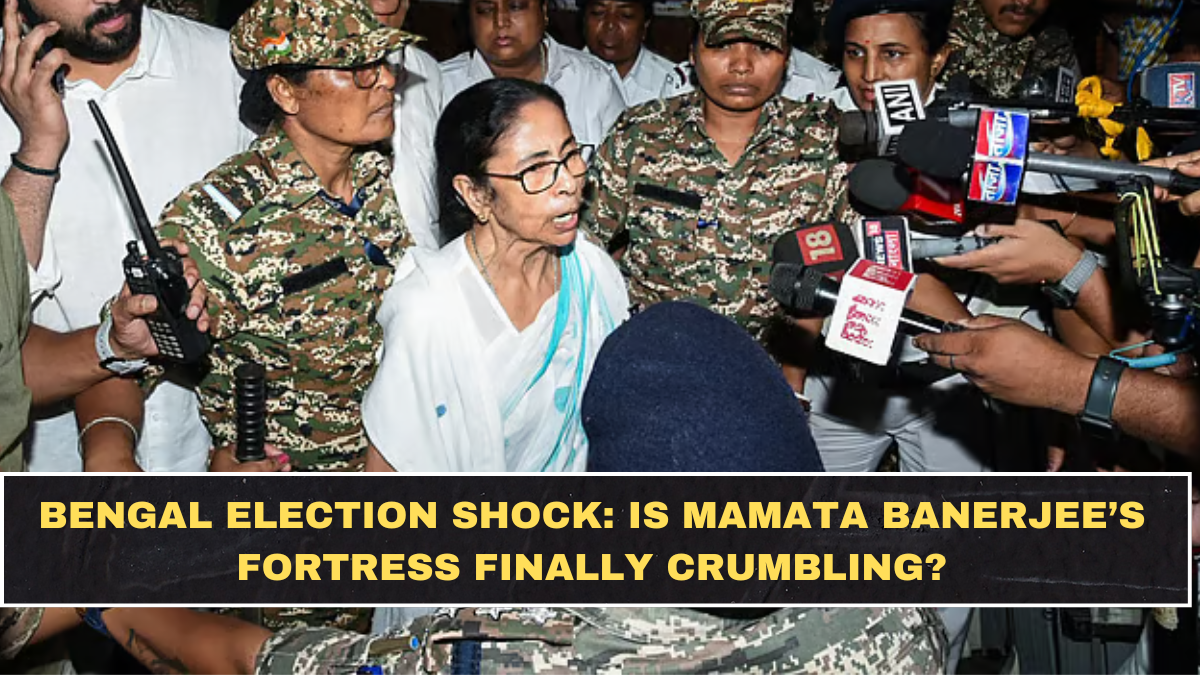
West Bengal has delivered one of the biggest political shocks of 2026, with the BJP winning a historic mandate and ending TMC’s long rule in the state. The Election Commission’s May 2026 results showed BJP winning 207 seats, while TMC was reduced to 80 seats in the Assembly. That is not a narrow defeat; it is a dramatic power shift in a state Mamata Banerjee dominated for years.
Reuters reported that BJP secured more than two-thirds of the 294-seat Assembly, while TMC’s tally dropped sharply from its earlier 215 seats to 80. The report also said Mamata Banerjee lost her own seat, making the verdict even more politically explosive. For a leader who ruled Bengal since 2011, this result is more than a setback; it is a collapse of fortress politics.

What Do The Bengal Numbers Reveal?
The numbers show that BJP did not just expand in Bengal; it crossed the line from challenger to ruler. TMC still has a base, but it has lost the power narrative and the state machinery advantage that comes with government. When a ruling party falls from 215 to 80 seats, voters are not sending a mild warning; they are demanding a full reset.
| Party | 2026 Result | Political Meaning |
|---|---|---|
| BJP | 207 seats | Historic first government in Bengal |
| TMC | 80 seats | Major fall from ruling dominance |
| Majority Mark | 148 seats | BJP crossed it comfortably |
| Assembly Strength | 294 seats | BJP secured over two-thirds |
| Mamata Banerjee | Lost seat | Huge symbolic blow |
This table exposes the uncomfortable truth for TMC. The party did not lose only because of one region, one candidate or one controversy. The defeat was broad enough to show that BJP successfully converted years of ground-building into a full electoral breakthrough. Bengal politics may now enter a completely different phase.
Why Did Mamata’s Fortress Crack?
Mamata Banerjee’s biggest strength was always her direct emotional connection with Bengal’s voters. But this election suggests that anti-incumbency, local anger, organisational fatigue and BJP’s aggressive campaign combined into a wave TMC could not contain. Reuters reported that Modi, Amit Shah and senior BJP leaders campaigned heavily, focusing on illegal immigration and the weak local economy under Banerjee.
The BJP’s success appears to have come from a mix of political messaging and booth-level expansion. It pushed hard on governance, security, identity and economic concerns while presenting itself as the force that could break TMC’s long dominance. The brutal point is simple: TMC looked like the establishment, and BJP looked like the vehicle of change.
Key reasons behind the BJP surge:
- Strong anti-incumbency after years of TMC rule
- Aggressive campaign by national BJP leadership
- Focus on economy, immigration and governance issues
- Better booth-level conversion in key constituencies
- Mamata’s personal seat loss weakening TMC’s morale
Why Is Mamata Refusing To Resign?
The post-result drama became even bigger after Mamata Banerjee refused to resign and claimed that the Election Commission was biased. Reuters reported that she alleged around 100 seats were “forcibly taken,” though she did not provide evidence. West Bengal’s Chief Electoral Officer called the allegations baseless, while BJP rejected her claims.
This refusal has turned the result from a political defeat into a constitutional flashpoint. Indian Express explained that the Governor can ask an outgoing Chief Minister to resign or wait until the term ends, after which the new Assembly and government formation process begins. A defeated candidate may also challenge results in court under election law, but that is a legal route, not a shortcut to reversing the mandate.
Is This Bigger Than Bengal?
Yes, because Bengal was one of the BJP’s toughest political frontiers. Reuters noted that BJP had never ruled West Bengal before and described the victory as a political milestone, especially as the party now controls almost all states in eastern India. That makes the Bengal result a national signal, not just a regional headline.
For BJP, this strengthens the “eastward expansion” story. For TMC, it raises an uncomfortable question: can Mamata rebuild from opposition after losing both power and personal invincibility? The answer depends on whether TMC accepts the verdict honestly or hides behind complaints without fixing its ground-level weakness.
Conclusion: Has Bengal Entered A New Era?
West Bengal’s 2026 result looks like the end of one political chapter and the beginning of another. BJP’s 207-seat win has demolished the idea that Bengal is permanently resistant to saffron politics. TMC still remains a major opposition force, but its fall from dominance is impossible to ignore.
The blunt reality is that Mamata Banerjee’s fortress has cracked badly. Refusing to resign may create headlines, but it cannot erase the scale of the verdict. If TMC wants a comeback, it needs serious rebuilding, not emotional denial. Bengal voters have delivered a message, and it is loud enough for all of India to hear.
FAQs
Who won the West Bengal election result 2026?
BJP won the West Bengal Assembly election 2026 with 207 seats, according to the Election Commission’s May 2026 results. TMC finished with 80 seats, marking a major political shift in the state.
Did Mamata Banerjee lose her seat?
Yes, Reuters reported that Mamata Banerjee herself lost her seat in the 2026 West Bengal election. This made TMC’s defeat more symbolic because the party’s top leader also suffered a personal electoral setback.
Why is BJP’s Bengal win historic?
BJP’s Bengal win is historic because the party had never ruled West Bengal before. It also secured more than two-thirds of the Assembly, turning a long-time TMC stronghold into a BJP-led state.
What happens if Mamata Banerjee refuses to resign?
The Governor can ask the outgoing Chief Minister to resign or wait until the term ends, after which the new Assembly is sworn in and the government formation process begins. A defeated candidate can also challenge the result in court through legal procedures.