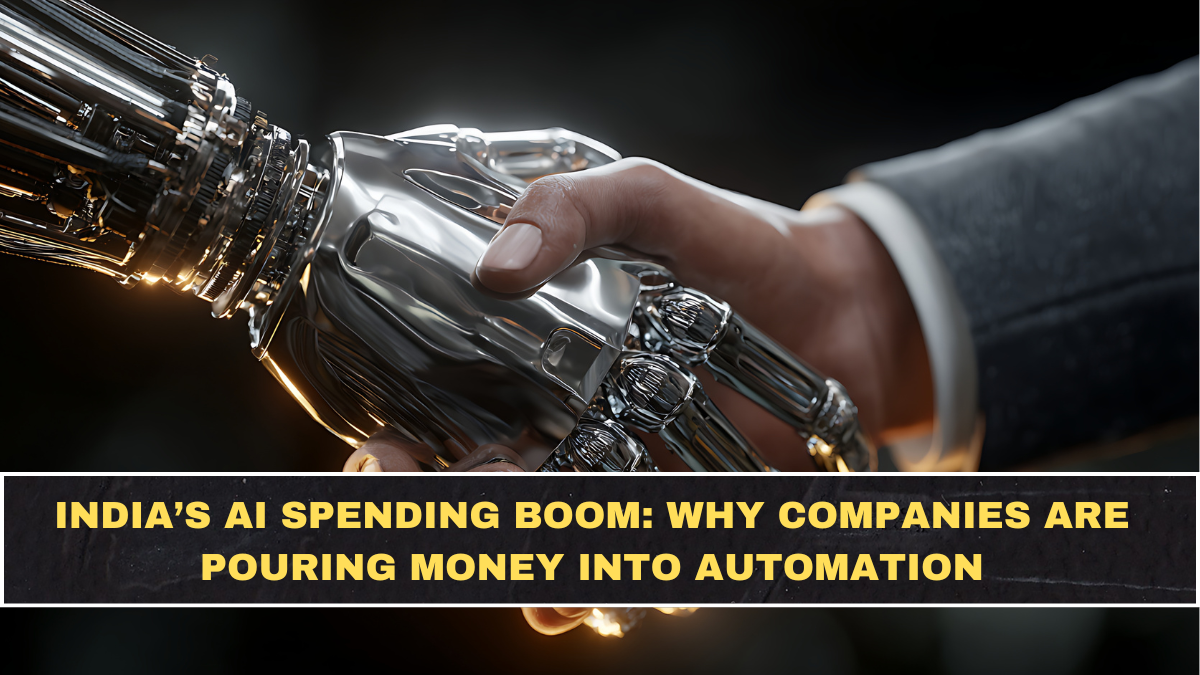
India’s AI spending boom is no longer just a startup story. Big enterprises are now putting serious money into artificial intelligence, data transformation, cloud modernisation and automation. A new Bain & Company report says India’s enterprise IT spending is expected to grow 6%–8% in 2026, faster than the 4%–6% global growth expected among peers.
This matters because companies are moving beyond small digital upgrades. They are now trying to rebuild how work happens inside finance, retail, manufacturing, banking, healthcare and customer support. The blunt truth is that companies not investing in AI now may soon look slow, expensive and outdated compared to competitors that automate faster.

Where Is The Money Going?
Bain’s report says around 40% of enterprise technology budgets in 2026 may go toward change initiatives, and 40%–45% of that change spend is expected to focus on AI and data-led transformation. That means AI is not sitting in a side experiment folder anymore. It is becoming part of core business spending.
The biggest spending areas are likely to include automation tools, analytics platforms, AI copilots, cybersecurity, cloud systems and data infrastructure. Companies want faster decision-making, lower operating costs and better customer experiences. But throwing money at AI without fixing messy data and old systems will not magically create results.
| Spending Area | Why Companies Care |
|---|---|
| AI Automation | Reduces repetitive work and improves speed |
| Data Transformation | Makes business decisions more accurate |
| Cloud Modernisation | Helps companies scale digital tools faster |
| Cybersecurity | Protects systems as AI-related risks rise |
| App Rationalisation | Cuts outdated tools and reduces tech waste |
Why Is This Bigger Than Chatbots?
Many people still think AI means only chatbots, but that is a shallow view. Enterprise AI is about automating workflows, predicting demand, detecting fraud, improving supply chains, analysing customers and helping employees make better decisions. In short, AI is moving from “cool tool” to “business engine.”
Bain’s India Enterprise Technology Report 2026 highlights that decision-makers are prioritising AI, transformation initiatives and stronger technology foundations. Fortune India also reported that around 60% of CIOs are expected to prioritise high-impact AI roadmaps, application rationalisation and data modernisation over the next year.
What Is The Biggest Problem?
The biggest problem is not lack of excitement. The biggest problem is weak execution. Many Indian companies want AI benefits, but their internal systems are still full of legacy software, scattered data, unclear ownership and poor measurement of return on investment.
Open Magazine’s summary of the Bain report noted that legacy systems, talent shortages and weak ROI measurement remain major barriers to large-scale business value. That is the uncomfortable part most companies avoid. AI spending looks impressive in boardroom slides, but without clean data and trained teams, it becomes expensive decoration.
Which Sectors Could Benefit Most?
AI spending can touch almost every sector, but the biggest early gains may come where companies handle large data, repeated processes and customer-heavy operations. Banking can use AI for fraud detection and risk scoring. Retail can use it for inventory and personalised offers. Manufacturing can use it for predictive maintenance and quality control.
Sectors to watch closely include:
- Banking and finance: fraud detection, credit scoring and customer support automation
- Retail and e-commerce: demand prediction, pricing and personalised shopping
- Manufacturing: predictive maintenance, supply-chain planning and defect detection
- Healthcare: diagnostics support, scheduling and patient-data analysis
- IT services: AI copilots, code review, testing and enterprise automation
Can AI Spending Create Jobs Or Kill Them?
Both can happen, and pretending otherwise is dishonest. AI will reduce demand for some repetitive roles, especially where work is rule-based and easy to automate. Basic data entry, simple ticket handling, manual reporting and routine back-office tasks are clearly at risk.
But AI can also create demand for new roles in data engineering, AI governance, prompt operations, cybersecurity, workflow design and automation management. The workers who survive this shift will not be the ones who ignore AI. They will be the ones who learn how to use it, supervise it and improve business results with it.
Conclusion?
India’s AI spending boom is a serious signal that enterprises are preparing for a more automated, data-driven future. Bain’s forecast of 6%–8% IT spending growth in 2026 shows that Indian companies are ready to spend more aggressively than many global peers. But spending alone does not guarantee transformation.
The harsh truth is that many companies will waste money on AI because they will buy tools before fixing systems, data and skills. The winners will be businesses that treat AI as a serious operating-model change, not a fancy software purchase. Automation is coming fast, and companies that move slowly may not get much sympathy later.
FAQs?
Why Is India’s AI Spending Rising?
India’s AI spending is rising because companies want faster operations, lower costs, better customer service and stronger data-driven decisions. Bain’s report says enterprise IT spending in India is expected to grow faster than global peers in 2026. AI and data transformation are becoming major parts of that technology budget.
How Much Will Indian Companies Spend On AI?
Exact company-wise spending will vary, but Bain says around 40% of enterprise technology budgets may go toward change initiatives in 2026. Out of that change-related spending, around 40%–45% is expected to focus on AI and data-led transformation. That makes AI one of the biggest enterprise technology priorities.
Which Jobs Are At Risk From AI Automation?
Jobs involving repetitive, rule-based and low-judgement tasks are most exposed to AI automation. This includes simple reporting, data entry, basic customer support and routine back-office work. However, people who learn AI tools, data skills and workflow automation can move into better roles.
What Is The Biggest Challenge For Companies Using AI?
The biggest challenge is execution, not buying tools. Many companies still have legacy systems, poor data quality, unclear AI governance and weak ROI tracking. Without fixing these issues, AI investments may look impressive but fail to deliver real business value.