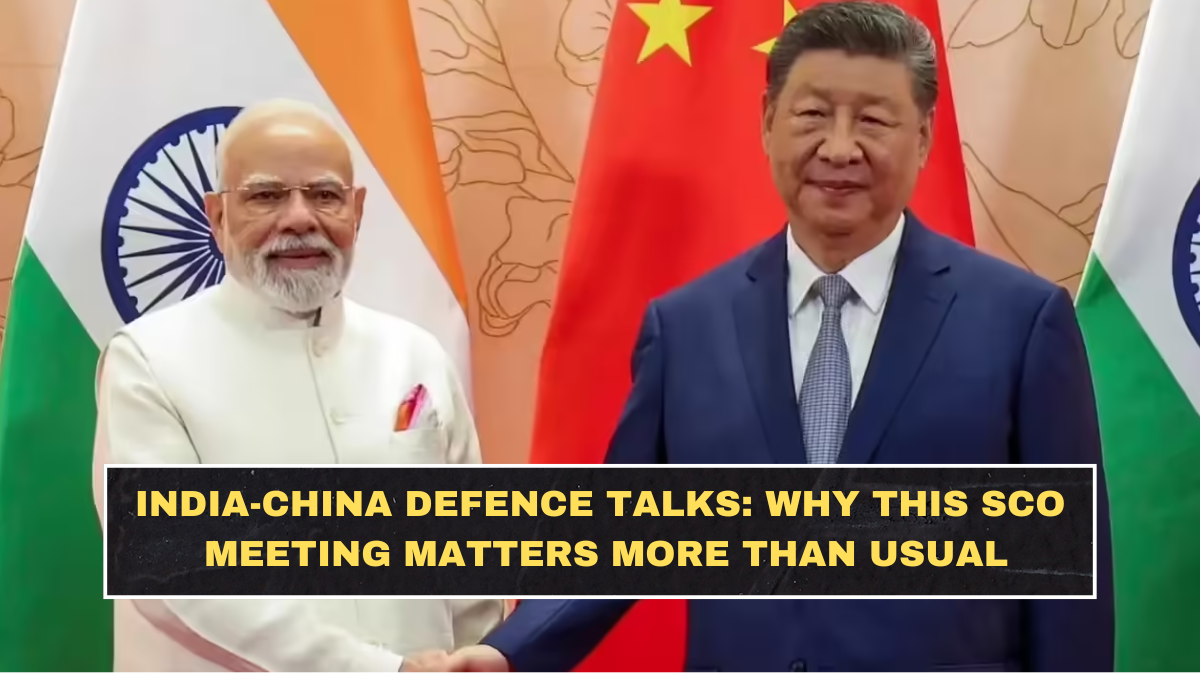
India’s Defence Minister Rajnath Singh met Chinese Defence Minister Dong Jun on the sidelines of the Shanghai Cooperation Organisation Defence Ministers’ Meeting in Bishkek, Kyrgyzstan. According to New Delhi, the two sides discussed regional security and avenues for defence engagement. This may sound routine, but it matters because India-China defence dialogue is never just a photo opportunity.
The meeting happened at a time when Asia is dealing with multiple pressure points: the Iran war, energy security fears, terrorism concerns, China’s military rise, India-China border sensitivities, and shifting Russia-China-Iran ties. In that environment, even a limited defence conversation between New Delhi and Beijing carries weight. It does not mean relations are fixed. It means both sides know silence is risky.
What Is The SCO And Why Does It Matter Here?
The Shanghai Cooperation Organisation is a Eurasian grouping that includes India, China, Russia, Kazakhstan, Kyrgyzstan, Pakistan, Tajikistan, Uzbekistan, Iran, and Belarus. India became a full member in 2017 and has used the platform to engage with regional powers while still protecting its own strategic independence. The Indian government said the Bishkek meeting would cover defence and security issues, international peace, counter-terrorism, and defence cooperation among SCO members.
The SCO matters because it puts rivals and partners in the same room. India and China are competitors. India and Pakistan are adversaries. Russia is close to both India and China, while Iran and Belarus bring another anti-Western layer into the forum. That makes the SCO messy, but useful. It allows dialogue even when trust is weak.
| Issue | Why It Matters For India-China Talks |
|---|---|
| Border tensions | India and China still need military communication |
| Terrorism | India wants stronger language against cross-border threats |
| West Asia crisis | Iran war affects energy and regional stability |
| Russia factor | Moscow remains close to both New Delhi and Beijing |
| SCO platform | Allows talks without a full bilateral summit |
Why Is This Meeting More Important Than Usual?
This meeting matters more than usual because the regional environment is much more unstable. The Iran war has shaken energy markets and supply chains. Russia is still locked in the Ukraine war. Iran is trying to deepen defence ties with Asian partners. China is talking more about energy security. India is trying to protect its interests without being dragged into anyone else’s bloc politics.
That is exactly why India-China defence communication matters. The two countries may not trust each other, but they cannot afford uncontrolled escalation. When two nuclear-armed neighbours with unresolved border issues stop talking, the risk of misunderstanding rises. Defence-level contact helps reduce that risk, even if it does not solve the bigger dispute.
What Did India Want To Highlight At The SCO?
India wanted to highlight terrorism, extremism, and regional security. The Ministry of Defence said Rajnath Singh would underline India’s zero-tolerance position on terrorism and extremism at the SCO meeting. That is not just a generic line. India uses forums like the SCO to push back against cross-border terrorism and to remind members that regional security cannot be separated from terror networks.
Indian media reported that Singh warned against state-sponsored terrorism and said those supporting terrorism should face “justifiable punishment.” The wording is clearly aimed at India’s security concerns, especially involving Pakistan-backed militancy. But inside the SCO, this message becomes more complicated because Pakistan is also a member, and China has often taken positions India dislikes on terrorism-related diplomacy.
Why Is The India-China Border Still The Main Shadow?
The India-China border dispute remains the biggest shadow over any defence engagement. Even when official statements focus on regional security, both sides know the real test is whether military tensions along the Line of Actual Control stay controlled. The Galwan clash in 2020 permanently changed Indian public and strategic thinking about China. Since then, dialogue has resumed in phases, but trust has not returned to normal.
This is why defence talks are useful but limited. A meeting in Bishkek cannot magically erase years of border friction. What it can do is keep communication channels open, prevent accidental escalation, and create space for further military and diplomatic contacts. That is not glamorous, but it is necessary.
How Does The Iran War Affect India And China Differently?
The Iran war affects both India and China, but not in identical ways. China is heavily dependent on Middle East energy flows and has a major interest in keeping shipping routes stable. India also depends on imported energy and has deep stakes in West Asian stability because of oil, trade, and millions of Indian workers in the Gulf.
This gives both countries a shared interest in preventing the crisis from spreading. But their strategic alignments differ. China is closer to Iran and Russia in many diplomatic settings, while India tries to balance ties with the US, Russia, Iran, Gulf states, and Israel. That makes India’s SCO role delicate. New Delhi wants dialogue, but it does not want to be absorbed into an anti-Western bloc.
Why Is Russia Still Important In These Talks?
Russia remains important because it has long-standing defence ties with India and a deep strategic partnership with China. At the same SCO meeting, regional leaders were also discussing security tensions involving Iran, Russia, and wider Eurasia. That means India-China talks do not happen in a vacuum. Moscow is always part of the background calculation.
India’s challenge is practical. It wants to preserve defence ties with Russia while also strengthening relations with Western partners. China, meanwhile, benefits from closer Russia ties but also competes with India across Asia. This triangular balance is one reason SCO meetings matter: they allow India to stay present in Eurasian security conversations instead of letting China and Russia shape them alone.
Does This Mean India-China Relations Are Improving?
It means communication is improving, not necessarily trust. That distinction is important. Meeting on the sidelines of an SCO summit shows both sides are willing to talk. It does not prove the border dispute is resolved, trade tensions are gone, or strategic rivalry has cooled. Anyone selling this as a breakthrough is overdoing it.
The smarter reading is cautious engagement. India and China are trying to manage rivalry, not end it. They understand that open hostility would damage both countries, especially during wider global instability. But neither side is ready to ignore hard security concerns.
What Should India Watch After This Meeting?
India should watch whether defence engagement leads to practical steps: more border commander talks, clearer communication mechanisms, fewer patrol confrontations, and stronger crisis-management channels. Speeches and handshakes mean little if they do not reduce risk on the ground.
India also needs to be careful inside the SCO. The organisation is useful, but it is not built around India’s worldview. China, Russia, Iran, and Belarus may push it toward a more anti-Western posture. India should participate, but not get trapped. Strategic independence means showing up without surrendering your own priorities.
Conclusion
The India-China defence talks in Bishkek matter because they happened during a period of unusually high regional stress. The two defence ministers discussed regional security and defence engagement at the SCO meeting, while India also pushed its zero-tolerance message on terrorism. That combination tells the real story: India wants dialogue, but not at the cost of its core security concerns.
The blunt truth is that one meeting will not fix India-China relations. The border dispute, strategic rivalry, and distrust remain. But talking is still better than drifting blindly into another crisis. In today’s Asia, controlled rivalry may be the most realistic goal.
FAQs
Why did India and China hold defence talks in Bishkek?
India’s Defence Minister Rajnath Singh met Chinese Defence Minister Dong Jun on the sidelines of the SCO Defence Ministers’ Meeting in Bishkek. The two discussed regional security and possible defence engagement.
What is the SCO?
The Shanghai Cooperation Organisation is a Eurasian grouping that includes India, China, Russia, Pakistan, Iran, Belarus, and several Central Asian countries. It focuses on regional security, counter-terrorism, political dialogue, and cooperation among member states.
Did the meeting solve India-China tensions?
No. The meeting shows communication, not resolution. India and China still have major strategic and border-related tensions, but defence dialogue can help reduce the risk of misunderstanding or escalation.
Why did India raise terrorism at the SCO meeting?
India uses SCO forums to highlight its zero-tolerance stance on terrorism and extremism. Rajnath Singh was expected to underline India’s position on counter-terrorism and regional security during the Bishkek meeting.