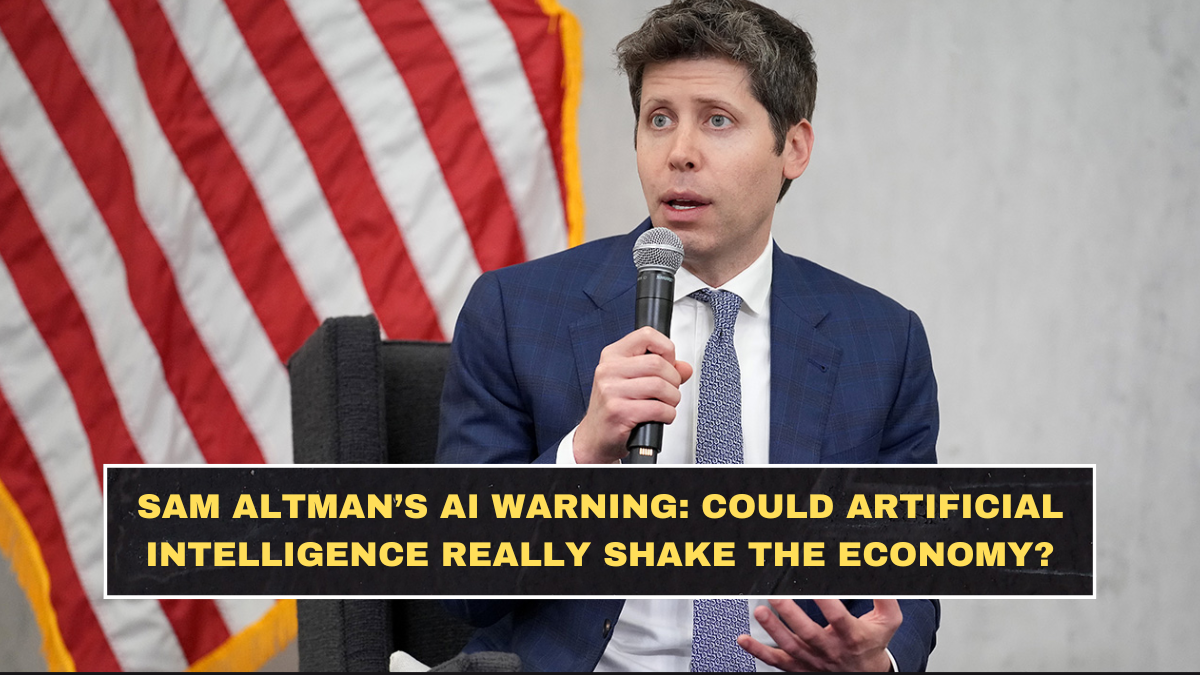
Sam Altman’s AI warning is getting attention because the OpenAI CEO has again raised concerns about how artificial intelligence could reshape jobs, companies, income, and the wider economy. A recent Times of India report said Altman warned that a post-AGI world could deeply disrupt work and even collapse today’s economic structure if humans no longer need to work in the same way.
That sounds dramatic, and honestly, it is dramatic. But the real issue is not whether the economy literally collapses overnight. The serious question is whether AI can disrupt enough jobs, wages, business models, and income distribution to force governments and companies to rethink how work and money function.
The lazy reaction is to say, “AI will take all jobs,” or “AI will create better jobs, don’t worry.” Both are too simple. The truth is messier. AI will create new work, destroy some work, reduce demand for certain roles, increase productivity in others, and reward people who know how to use it better than those who ignore it.
What Did Altman Mean By AI Shaking The Economy?
Altman’s concern is linked to artificial general intelligence, or AGI, which means AI systems that can perform many intellectual tasks at or above human level. If such systems become widely available, companies may need fewer people for some kinds of knowledge work, customer support, coding, research, operations, writing, analysis, and admin tasks.
He has also previously said AI will affect the job market but added that humans usually find new things to do. Times of India reported in February 2026 that Altman acknowledged job disruption while saying he believed people would discover better kinds of work over time.
So his position is not simply “AI will destroy everything.” It is closer to this: AI can bring huge abundance and productivity, but the transition may be brutal if society does not prepare. That is the part people should focus on. The danger is not only the technology. The danger is weak planning by governments, schools, companies, and workers.
Which Jobs Could Face The Most Pressure?
The jobs most exposed are tasks-based roles where work can be described, repeated, measured, and automated. That includes parts of customer service, data entry, basic coding, content production, document review, report writing, research assistance, translation, scheduling, quality checking, and back-office operations.
This does not mean every worker in these fields will disappear. It means the number of people needed for the same output may fall. One person with AI tools may do the work that previously required three or five people. That is where the job pressure begins.
| Job Area | Why AI Can Affect It | Likely Impact |
|---|---|---|
| Customer support | AI can answer common queries instantly | Fewer agents for basic tickets |
| Coding | AI can generate and debug code | Junior roles may become harder |
| Content writing | AI can draft articles, ads, emails, scripts | Low-quality writing gets replaced |
| Data entry | Repetitive structured work is easy to automate | Manual roles shrink |
| Research assistance | AI can summarize and compare information | Faster output, fewer basic tasks |
| Admin operations | Scheduling, reporting, and documentation can be automated | Leaner teams |
The uncomfortable truth is that average workers doing average repeatable work are most vulnerable. If your only value is “I can follow instructions,” AI is coming directly for that lane. The safer path is judgment, domain knowledge, client handling, creativity, problem-solving, leadership, and tool mastery.
Are Companies Already Cutting Jobs Because Of AI?
Some companies are clearly restructuring around AI, but not every layoff blamed on AI is truly caused by AI. The Guardian reported that Meta and Microsoft announced major staff reductions while making large AI investments, with Meta planning to cut nearly 8,000 jobs and Microsoft offering voluntary retirement packages to thousands of US staff.
At the same time, Altman has warned that some companies may be using AI as an excuse for layoffs they would have done anyway. India Today reported that he described this as “AI washing,” where businesses blame AI for job cuts even when the real reasons may include cost reduction, weak demand, restructuring, or overhiring.
That distinction matters. AI is a real force, but companies also use fashionable explanations to make painful decisions look strategic. Workers should not be naive. Some layoffs are genuinely AI-linked. Some are old-fashioned cost cutting with AI branding pasted on top.
Could AI Create New Jobs Too?
Yes, AI will create new jobs, but that does not automatically help the people whose old jobs disappear. New roles may appear in AI operations, prompt design, model evaluation, AI safety, automation consulting, data governance, workflow design, cybersecurity, AI training, product management, and industry-specific AI implementation.
Reuters reported that OpenAI itself planned to nearly double its workforce to 8,000 by the end of 2026, showing that AI companies are also hiring aggressively in product, engineering, research, and sales. That is the contradiction people need to understand: AI can destroy jobs in one part of the economy while creating high-value jobs in another.
The problem is mismatch. A customer support agent cannot automatically become an AI engineer. A junior writer cannot automatically become an automation strategist. Reskilling sounds nice in speeches, but it requires time, money, guidance, and discipline. Without that, AI will increase inequality between people who adapt and people who are left behind.
What Could Happen To Businesses And Wages?
Businesses may become leaner, faster, and more profitable if AI allows them to produce more with fewer employees. That can be good for productivity and shareholders, but it can be painful for workers if wages stagnate or hiring slows. If companies need fewer entry-level workers, young people may struggle to get their first real career opportunity.
This is already becoming a fear in several industries. A recent Fortune report said anti-AI sentiment has been rising among younger people, partly because they fear AI is killing entry-level jobs. That fear is not irrational. Entry-level jobs are often made of basic tasks, and those are exactly the tasks AI is getting better at doing.
If entry-level work shrinks, the whole career ladder becomes weaker. Companies still want experienced workers, but where will experience come from if beginners cannot get hired? That is one of the biggest blind spots in the AI jobs debate.
What Should Workers Do Now?
Workers should stop treating AI as either a toy or a threat they can ignore. The practical move is to learn how AI applies to their current job and then move toward higher-value tasks that require judgment, human trust, and business understanding. Waiting for employers or governments to protect you is a weak strategy.
If you work in support, learn AI-assisted workflows, escalation handling, quality review, customer experience analysis, and automation design. If you write content, learn research, editorial judgment, SEO strategy, subject expertise, and fact-checking. If you code, learn system design, debugging, architecture, and product thinking instead of only syntax.
The harsh truth is simple: AI will not replace every person, but people using AI will replace many people who refuse to use it. That line is becoming reality faster than most workers want to admit.
Conclusion?
Sam Altman’s AI warning matters because it points to a real economic question: what happens when machines can do large parts of knowledge work faster and cheaper than humans? The answer is not simple collapse, but it may involve serious disruption in jobs, wages, hiring, business models, and inequality.
The smart response is not panic. It is preparation. Workers need AI skills, companies need responsible transition plans, schools need updated training, and governments need policies for displaced workers. AI can create abundance, but without planning, it can also create a brutal divide between those who adapt and those who get replaced.
FAQs
What Did Sam Altman Warn About AI And The Economy?
Sam Altman warned that advanced AI and AGI could deeply disrupt work and today’s economic system. His concern is that if machines perform many human tasks, jobs, wages, and income distribution may need major restructuring.
Will AI Take All Jobs?
No, AI is unlikely to take all jobs, but it can reduce demand for many repeatable and task-based roles. Jobs involving judgment, human trust, creativity, leadership, and domain expertise may remain stronger.
Which Jobs Are Most At Risk From AI?
Customer support, data entry, basic coding, low-level content writing, admin work, research assistance, and repetitive back-office roles are more exposed. These jobs include many tasks AI can already automate or speed up.
How Can Workers Protect Their Careers From AI?
Workers should learn AI tools, build domain expertise, improve problem-solving ability, and move toward higher-value work. The goal is not to compete with AI on speed, but to use AI while adding judgment, strategy, and human understanding.