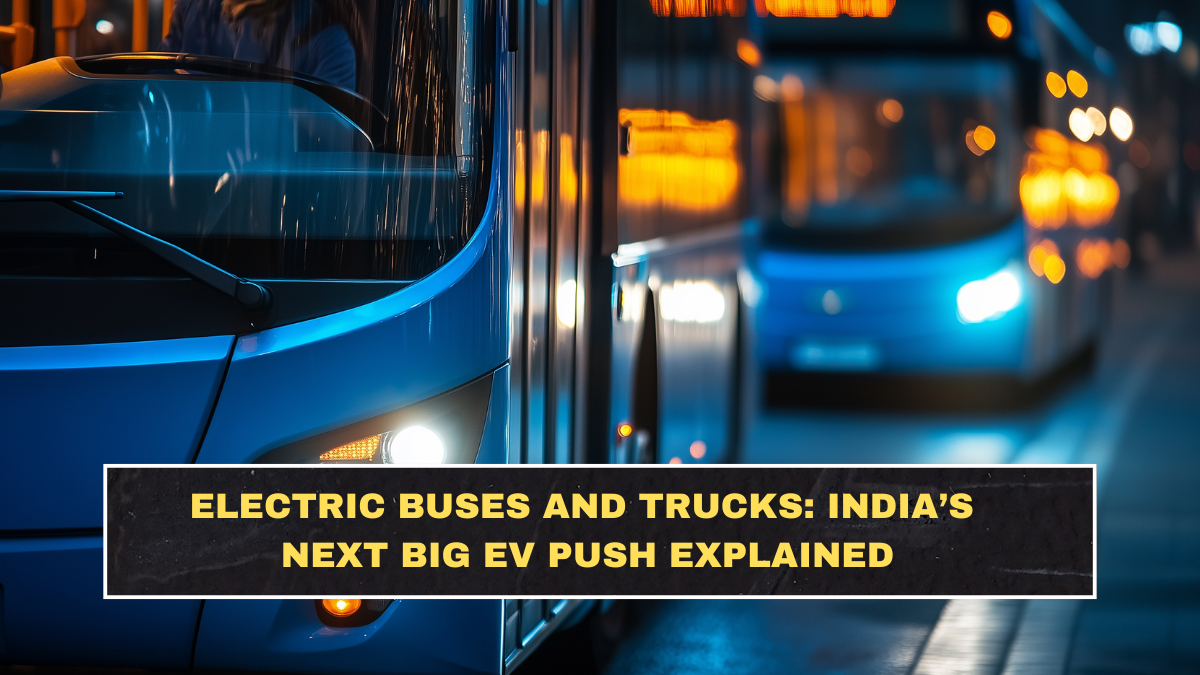
India is pushing electric buses and trucks because the next big EV battle is no longer only about scooters and cars. Public transport and freight vehicles run more kilometres, consume more fuel and create higher urban pollution impact than most private vehicles. If India wants cleaner cities and lower fuel dependence, buses and trucks cannot be ignored.
The Ministry of Heavy Industries held a high-level meeting on April 29, 2026, to discuss financing mechanisms for faster adoption of electric buses and electric trucks in the private sector. The meeting focused on financing challenges, current funding status, possible solutions and the kind of government support needed to make e-buses and e-trucks viable at scale.
What Did The Heavy Industries Ministry Discuss?
The meeting looked at why private companies are still hesitant to buy electric buses and trucks despite growing policy support. The biggest issue is not only technology; it is finance. Electric commercial vehicles usually have a higher upfront cost than diesel vehicles, even if their running cost can be lower over time.
Reports said the government discussed options such as financing support, credit mechanisms and ways to reduce lender risk. Livemint reported that the Centre is considering tools such as partial credit guarantees and interest subvention support to encourage private-sector adoption of electric buses and trucks.
| Issue | Why It Matters For E-Buses And E-Trucks |
|---|---|
| High upfront cost | Electric commercial vehicles cost more at purchase |
| Financing hesitation | Banks and NBFCs worry about resale value and battery risk |
| Charging infrastructure | Depots and highways need reliable chargers |
| Private adoption | Government fleets alone cannot scale the market |
| Running cost | EVs may save money over long usage cycles |
| Pollution impact | Buses and trucks affect urban air quality heavily |
| Policy support | Funding tools can reduce risk for buyers and lenders |
Why Are Electric Commercial Vehicles Harder To Finance?
Electric buses and trucks are harder to finance because lenders are still learning how to price their risk. A diesel truck has a known resale market, known maintenance pattern and years of financing history. An electric truck has battery-life questions, charging-infrastructure dependency, uncertain resale value and new technology risk.
This is why banks and NBFCs may charge higher interest rates or avoid lending aggressively. That slows adoption even when fleet operators want to switch. The government’s challenge is simple: if lenders remain nervous, electric commercial vehicles will remain stuck in pilot projects instead of becoming a mainstream transport option.
What Is PM E-DRIVE’s Role In This Push?
PM E-DRIVE is India’s major electric mobility support scheme, and it includes support for electric buses, electric trucks, electric two-wheelers, electric three-wheelers, electric ambulances and charging infrastructure. The official PM E-DRIVE portal says the scheme aims to incentivise over 14,000 e-buses across nine major cities with populations above four million.
The scheme has also been extended by two years, from March 31, 2026, to March 31, 2028, according to a Ministry of Heavy Industries update released in August 2025. This matters because electric bus and truck deployment needs longer timelines for procurement, localisation, depot upgrades, charging infrastructure and financing arrangements.
Why Do Electric Buses Matter For Cities?
Electric buses matter because city buses run predictable routes and return to depots, making them easier to electrify than many other vehicle types. A bus can be charged at a depot, run fixed routes during the day and reduce diesel emissions in crowded urban areas where people are directly exposed to pollution.
For passengers, the benefit is also practical. Electric buses are usually quieter, smoother and cleaner at the point of use. For cities, they can reduce fuel costs over time if charging infrastructure, maintenance contracts and fleet utilisation are handled properly. But if depots are not ready, buses can sit idle. That is the operational failure India must avoid.
Why Are Electric Trucks More Complicated?
Electric trucks are more complicated because freight movement is less predictable than city bus routes. Trucks may travel long distances, carry heavy loads and need dependable highway charging. If a truck stops for hours because charging is unavailable or slow, the business case breaks quickly.
That is why e-truck adoption needs more than purchase subsidies. India needs highway charging corridors, depot charging for logistics companies, battery warranties, financing support and confidence in vehicle performance. Without that ecosystem, electric trucks will remain attractive on paper but risky for fleet operators.
How Can This Help Pollution And Fuel Imports?
Electric buses and trucks can reduce tailpipe emissions in cities and logistics corridors. This is especially important in urban areas where diesel buses and heavy vehicles contribute to particulate pollution and poor air quality. Cleaner commercial transport can help public health more directly than switching a small number of premium private cars.
There is also a fuel-import angle. India imports a large share of its crude oil, so reducing diesel demand in transport can improve energy security over time. The impact will not appear overnight, but large-scale electrification of buses and trucks can reduce long-term exposure to oil-price shocks if electricity supply and charging networks are strengthened.
What Are The Biggest Roadblocks?
The first roadblock is cost. The second is charging infrastructure. The third is lender confidence. The fourth is execution. India often announces good schemes but then gets stuck in tender delays, localisation requirements, depot readiness problems and slow approvals. That is where the real battle will be won or lost.
Recent reports show this problem clearly. Moneycontrol reported in March 2026 that the government eased PM E-DRIVE rules by allowing e-bus and e-truck makers to import traction motors until August-end, after local manufacturing deadlines were extended. That suggests the supply chain is still catching up with policy ambition.
What Should Fleet Operators Watch Before Buying?
Fleet operators should not buy electric buses or trucks just because subsidies sound attractive. They need to calculate total cost of ownership, daily kilometres, charging time, battery warranty, financing cost, route predictability and downtime risk. A cheap loan is useless if the vehicle cannot run reliably on the route.
They should also check whether chargers are available at depots, warehouses or highways before committing. This is where many operators fool themselves. They compare diesel cost with electricity cost but ignore charging delays, route planning, maintenance contracts and resale uncertainty. That is weak business planning.
Conclusion?
India’s electric buses and trucks push is important because it targets the vehicles that can make a serious difference to pollution, fuel use and transport costs. The Heavy Industries Ministry’s financing meeting shows the government understands that subsidies alone are not enough. Banks, NBFCs, fleet operators, manufacturers and charging companies must all be part of the solution.
The blunt truth is that India’s EV transition will not be won by flashy electric cars alone. Buses and trucks carry the real transport weight. If financing, charging and execution are fixed, this push can change public transport and freight. If not, it will become another policy announcement that looks better in headlines than on roads.
FAQs
Why Is India Focusing On Electric Buses And Trucks?
India is focusing on electric buses and trucks because they run more kilometres, consume more fuel and create larger pollution impact than many private vehicles. Electrifying them can improve urban air quality, reduce diesel use and support cleaner public transport and freight movement.
What Financing Support Is Being Discussed For E-Buses And E-Trucks?
Reports say the government is exploring financing tools such as partial credit guarantees and interest subvention support. These can reduce lender risk and make it easier for private fleet operators to buy electric buses and trucks.
What Is PM E-DRIVE?
PM E-DRIVE is a government scheme supporting electric mobility categories such as e-buses, e-trucks, electric two-wheelers, electric three-wheelers, electric ambulances and charging infrastructure. It aims to support large-scale adoption of cleaner transport in India.
What Is The Biggest Challenge For Electric Trucks?
The biggest challenge for electric trucks is reliable charging and route economics. Trucks need dependable highway or depot charging, strong battery warranties, good financing and minimal downtime. Without that, fleet operators may find electric trucks too risky despite policy support.